When an international steel project specification says only “comply with American standards” or “fabricate to European standards,” it leaves the most important questions unanswered. Which material grade and edition apply? Which welding code governs production? Who may inspect the work? What evidence must travel with each component?
For overseas buyers, these details are not paperwork added after fabrication. They shape material availability, welding qualifications, inspection effort, lead time and price from the quotation stage. A reliable supplier therefore converts a broad reference to steel structure standards into an executable technical package before releasing material or shop drawings.
AISC, EN 1090 and GOST are different compliance systems
American, European and Eurasian projects do not use three translations of the same rulebook. Each market combines design, materials, welding, execution, inspection and documentation in a different way.
| Project system | Typical references | Questions to settle before fabrication |
|---|---|---|
| United States / AISC route | AISC 360 and AISC 303; ASTM material and fastener standards; AWS D1.1 for structural welding | Material specification and edition, connection design responsibility, approved WPS, welder qualifications, inspection scope and acceptance criteria |
| European / EN route | Eurocode 3, EN 1090-1 and EN 1090-2, EN 10025 materials and supporting ISO welding standards | Execution class, material subgrade, Factory Production Control scope, welding coordination, inspection level, tolerances and CE-related deliverables where applicable |
| Eurasian / GOST-SP route | Applicable GOST material/product standards, SP design rules and project-specific EAC or national requirements | Exact country and authority requirements, climatic category, approved material equivalents, certification scope, Russian-language records and acceptance procedure |
The table is a starting point, not a substitute for the contract. The governing specifications, editions and project jurisdiction must be named. A buyer should be cautious when a fabricator says it can “do AISC, CE and GOST” but cannot explain how its material records, welding documents and inspection plan change for each route.
Material equivalence is an engineering decision
Yield strength alone does not make two grades interchangeable. ASTM A36, ASTM A572 Grade 50, EN S355 and Chinese Q355 grades can differ in chemistry, toughness, dimensional standards, delivery condition and certification. The structural design rules applied to them also use different resistance models and buckling checks.
Before accepting a substitution, the responsible engineer should review at least:
- the complete material standard, grade, subgrade and edition;
- minimum yield and tensile strength across the required thickness range;
- impact-test temperature and toughness requirements;
- chemical composition, carbon equivalent and weldability;
- delivery condition, such as as-rolled, normalized or thermomechanically rolled;
- section dimensions, tolerances and availability;
- the effect of substitution on member and connection calculations; and
- the inspection certificate and traceability documents required by the contract.
This review needs to happen before pricing is frozen. Imported sections, low-temperature grades and uncommon profiles can have long procurement cycles. Replacing a rolled section with a welded built-up member may solve availability, but it adds cutting, welding, distortion control and nondestructive testing. The correct comparison is total installed risk and cost, not simply the price per tonne of steel.
Welding compliance depends on qualified procedures and people
The production team may use similar welding equipment for different markets, but the qualification path and evidence are not the same.
On an AWS D1.1 project, the fabricator must establish compliant welding procedure specifications, procedure qualification records where required, and welder performance qualifications. Inspection personnel must meet the qualification requirements stated in the code and contract; a project may specifically require an AWS Certified Welding Inspector, but that requirement should be written rather than assumed.
For EN 1090 execution, the specified execution class drives many fabrication and inspection controls. The welding system commonly draws on ISO 3834 quality requirements, ISO 15614 procedure qualification, ISO 9606 welder qualification and ISO 14731 welding coordination. The precise route depends on the product, process, material group and contract.
GOST-based projects require an equally specific review. Requirements vary by destination country, sector and approving authority. A supplier should not treat “Russian standard” as one generic certificate. The project team needs to confirm the governing technical regulations, required approvals, acceptable material documentation, personnel qualifications and language of the dossier.
The inspection and test plan turns standards into production gates
A well-built inspection and test plan (ITP) connects the contract to the factory workflow. It defines what is checked, who participates, which record is produced and whether fabrication may continue.
For buyers and EPC teams, the ITP should identify:
- material certificate review and positive identification where required;
- drawing and procedure approval before production;
- first-article inspection for critical or repeated assemblies;
- fit-up, welding and dimensional inspection stages;
- nondestructive testing method, extent, timing and acceptance criteria;
- surface preparation, environmental conditions and coating checks;
- trial assembly or pre-assembly requirements;
- marking, packing and loading verification; and
- hold, witness and document-review points for the buyer or third party.
Too many hold points can stop a production line; too few can allow a nonconformity to move into an irreversible stage. The number, notice period and release authority for each point should therefore be agreed before the schedule is committed. Adding a third-party witness after fabrication has started often means reopening packages, repeating inspections and losing shipping windows.
Tolerances, bolts and coatings must also follow the selected system
Standard alignment extends beyond steel grades and welds. Fabrication and erection tolerances may be governed by AISC 303, EN 1090-2 or the applicable GOST/SP documents. A value acceptable under one system may not meet another project’s requirement.
High-strength bolting is another common source of mismatches. ASTM F3125 assemblies and EN 14399 preloaded bolting systems have different component combinations, product markings and installation procedures. Bolts, nuts and washers should be procured as an approved system, with the tightening method and verification requirements defined in the installation documents.
For corrosion protection, the project must connect the environment, design life, surface preparation, coating products, number of coats and dry film thickness. ISO 12944 is widely used internationally, while American projects may reference AMPP/SSPC surface-preparation standards and ASTM requirements. “Apply anti-corrosion paint” is not an adequate specification for a marine, chemical or high-humidity environment.
What overseas buyers should define in the RFQ
A technically complete request for quotation should include, or ask the fabricator to confirm, the following items:
- Design basis: governing design code, loading data, design responsibility and connection-calculation scope.
- Materials: standards, editions, grades, subgrades, delivery condition and permitted substitutions.
- Execution: fabrication standard, execution class or equivalent quality level, and dimensional tolerances.
- Welding: governing code, procedure and welder qualification requirements, and welding coordination responsibilities.
- Inspection: ITP, NDT methods and percentages, acceptance criteria, third-party participation and release points.
- Bolting and coatings: complete assembly and installation requirements, exposure category, surface preparation and coating system.
- Deliverables: drawing format, document language, number of copies, traceability level and final manufacturing record book.
- Logistics: component marking, packing, container or break-bulk constraints, shipping sequence and destination-country documentation.
When these boundaries are clear, suppliers can quote on the same technical basis and buyers can compare offers more reliably. It also reduces the risk that a low initial price turns into substitutions, repeated approvals, additional inspections or rework.
One production capability, market-specific evidence
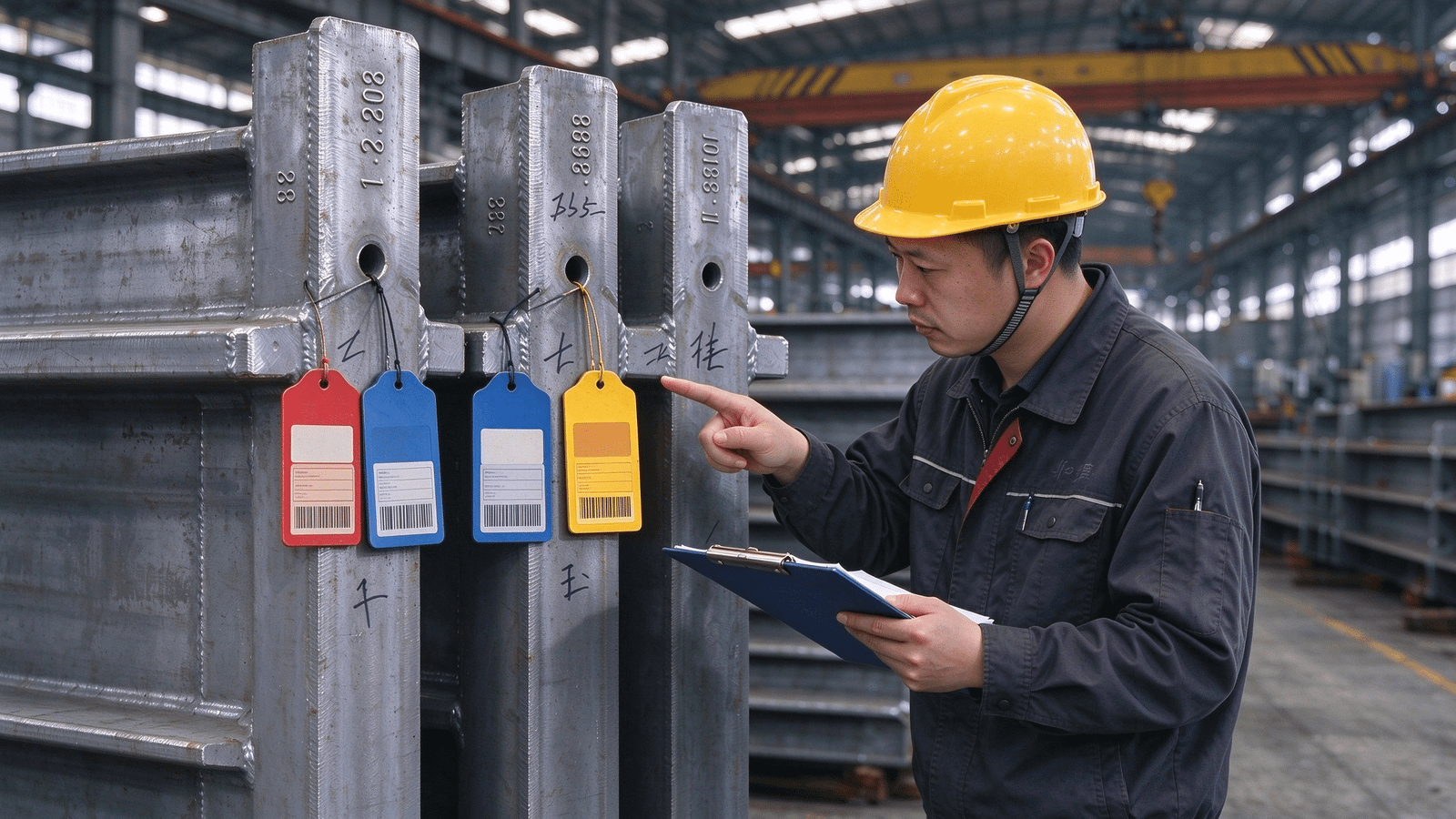
A mature export fabricator does not merely build a component and add a different certificate at the end. It plans a market-specific evidence chain from material receipt to final release: certificates tied to heat numbers, component IDs tied to weld and inspection records, coating reports tied to the approved system, and packing lists tied to erection or shipping sequences.
The practical test is simple: can every finished member be traced back to the approved drawing, material, welder, inspection result and coating record required by the buyer’s system? If the answer is yes, the factory is not only capable of making steelwork—it is capable of proving compliance.
Zhonghengfeng supports international steel structure projects with detailing, fabrication, quality control, documentation and export coordination. If you are preparing an RFQ under AISC/AWS, EN 1090 or a GOST-based specification, contact our project team with the design basis, destination, tonnage and required delivery date. We can review the specification boundaries before quotation and identify the documents and inspection stages needed for execution.