
An international structural steel package is not simply a domestic fabrication order with a longer truck journey. Distance magnifies every interface. A missing inspection record can delay release; an unclear shipping mark can slow material receipt; a member loaded in the wrong sequence can obstruct erection. Owners, EPC contractors and procurement teams should therefore evaluate the whole delivery chain—from approved information in the workshop to identifiable components at the site.
This does not mean that one supplier must control every international activity. Responsibilities differ by contract and Incoterm. It means that interfaces, inputs, outputs and acceptance points must be explicit. The strongest plan treats information, physical steel and schedule as three synchronized flows.
Define the delivery basis before fabrication
At order placement, the parties should agree the scope boundary, governing standards, approved-for-fabrication information, inspection and test plan, document language, packing requirements and shipping responsibilities. The destination’s import rules and the agreed Incoterm should be reviewed by qualified logistics and customs parties. Requirements vary by country, commodity classification and contract; generic assumptions are risky.
A responsibility matrix is useful. It can identify who approves drawings, releases material, witnesses inspections, prepares origin or conformity documents, arranges transport and confirms site readiness. Each handover should have a due date and acceptance criterion. This prevents tasks from falling into the gap between fabricator, freight forwarder, customs broker and erection contractor.
Build traceability into workshop production
Traceability should start when material is received, not after a client asks for a dossier. Material identification needs to remain connected to the relevant certificates through cutting and assembly. Member marks should correspond with drawings, packing lists and inspection records. Weld identification, personnel records and NDT reports should be retrievable at the level required by the contract.
Records should be created in the agreed project language or in a controlled bilingual format. Unplanned translation at the end of production can introduce inconsistent technical terminology, unit errors and mismatched references. Templates agreed early allow inspectors and client teams to read the same information throughout manufacture.
Use inspection gates to protect downstream work
The inspection and test plan should distinguish routine surveillance, witness points and hold points. Release authority must be clear. A coating operation, for example, can conceal surfaces and identification needed for earlier inspection; shipment can make a dimensional problem much more expensive to correct.
Inspection extent must follow the project documents rather than broad claims that international projects always require a particular percentage. Typical controls cover incoming material, fit-up, welding, dimensional conformity, surface preparation, coating and final identification. If third-party inspection is required, notice periods and document access should be included in the production schedule.
Control dimensions and interfaces before dispatch
Site compatibility depends on more than overall member length. Hole patterns, connection geometry, bearing surfaces, camber, orientation and interfaces with concrete or equipment may all be critical. The team should identify these characteristics during drawing review and assign appropriate checks.
Trial assembly can be valuable for complex or highly constrained connections, but it is not automatically necessary for every member. The project team should select its extent based on geometry, tolerance accumulation, erection risk and specification requirements. Digital surveys, templates or matched marking may be suitable alternatives in some cases.
Engineer packing for the transport route
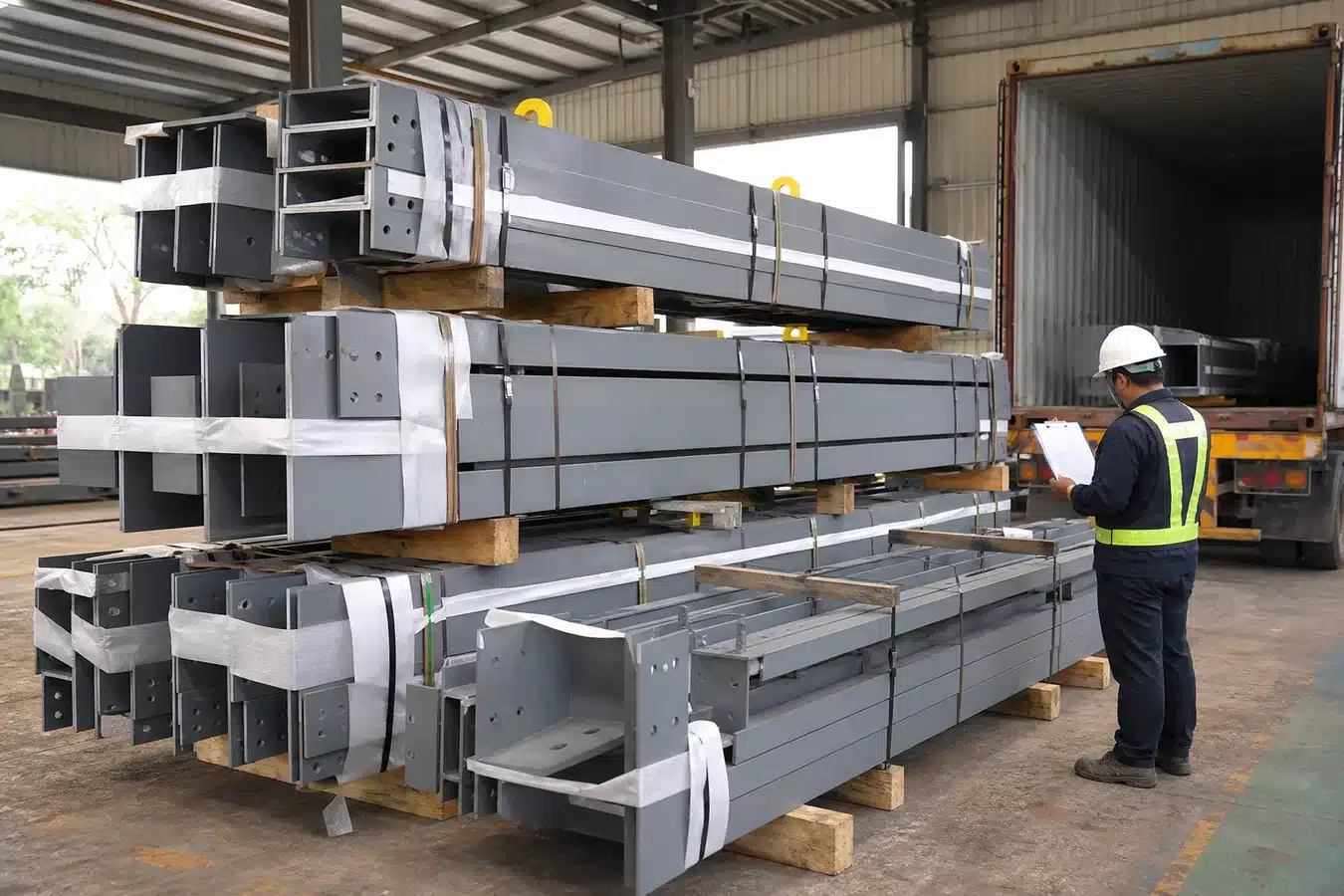
Export packing protects geometry, coating, identification and safe handling. The correct solution depends on member size, transport mode, route, expected storage time and lifting method. Supports and restraints should prevent movement and local damage without creating water traps or coating abrasion. Small loose items require robust, countable containers linked to erection zones.
- Show durable member marks that remain readable after transport.
- Identify package number, gross weight and dimensions accurately.
- Mark lifting points or center-of-gravity information where required for safe handling.
- Protect machined faces, threads and prepared connection surfaces.
- Use compliant packaging materials and destination-specific treatments where applicable.
- Provide packing lists that reconcile with drawings and shipping documents.
Photographic packing records can help resolve receipt questions, but they should supplement rather than replace formal inspection and packing documentation.
Align shipment sequence with erection readiness
Loading solely to maximize transport efficiency can conflict with erection priorities. The logistics plan should balance vessel or container constraints with site access, laydown capacity, crane sequence and temporary stability needs. Packages should be grouped so that the site can identify and retrieve them without repeatedly moving unrelated steel.
| Interface | Information to confirm | Risk if missed |
|---|---|---|
| Fabrication to inspection | ITP status, records, accessible surfaces | Release delay or hidden nonconformity |
| Inspection to packing | Release note, identification, coating status | Unapproved steel is packed |
| Packing to freight | Weights, dimensions, lifting and restraint plan | Unsafe handling or booking changes |
| Freight to customs | Consistent commercial and technical documents | Queries, storage or demurrage |
| Delivery to erection | Receipt sequence, laydown map, latest drawings | Double handling and lost time |
Treat customs as a planned interface, not a promise
No fabricator can responsibly guarantee clearance time across every border. Classification, valuation, origin evidence, permits and inspections depend on the jurisdictions and shipment. A competent customs broker should review the document set before dispatch. Descriptions, quantities, weights and values must be consistent across the commercial invoice, packing list, transport document and supporting certificates.
The schedule should include realistic document review and contingency rather than assuming immediate release. It should also define who pays potential storage or handling charges under the contract.
Prepare the site to receive usable information
The final handover should give the erection team current drawings, packing lists, material locations, inspection releases and procedures within its scope. Receipt inspection should record transport damage, shortages and identification issues promptly. Nonconformance and technical-query routes need named contacts and response times, especially when workshop and site operate in different time zones.
The central lesson is interface discipline. Fabrication, inspection, logistics and site teams can each perform well while the package still fails at their boundaries. A shared register of deliverables, releases and changes makes those boundaries visible. If you are preparing procurement requirements for an international steel package, Contact Us to discuss the fabrication and documentation scope.