
A fabrication warehouse is an operating control point, not simply a place to store material. What enters must be checked and recorded; what leaves must be linked to an authorized requirement; and the balance must remain visible enough to support production planning. A source article from Zhonghengfeng Group’s Steel Structure Manufacturing Plant No. 1 describes these routines through the work handled by warehouse administrator Guo Guixia.
The original profile uses gendered comparisons and absolute praise. Those elements do not help explain the process and have been removed. The operational facts are more useful: Guo was responsible for accepting incoming materials and equipment, recording receipts, issuing items, monitoring inventory, supporting material plans, organizing and labeling stored goods, and checking power and anti-theft facilities.
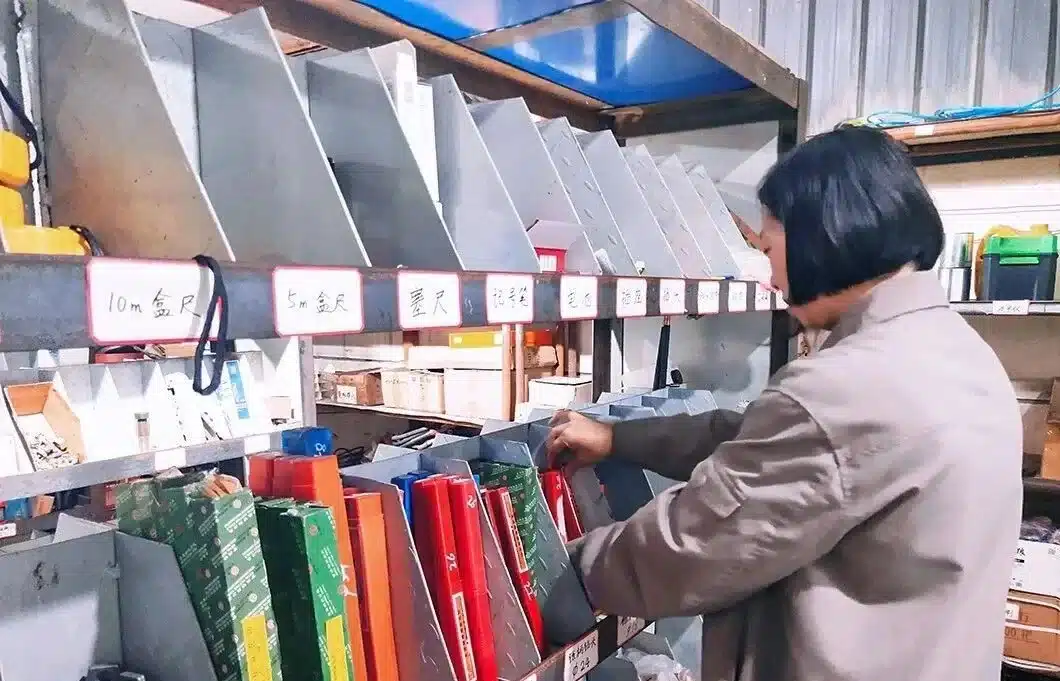
Receiving: The First Warehouse Control
The source states that incoming materials were counted, inspected and registered before storage. This first control protects subsequent fabrication. If the received quantity, visible condition or identification does not match the relevant documentation, the difference should be recorded and resolved before unrestricted use. The source does not specify standards, testing methods or digital systems, so no particular procedure is attributed to the plant beyond the described acceptance and registration.
A clear receiving record should connect the delivery document, material description, quantity, date, storage location and inspection status. For project-specific steelwork, it can also carry the applicable project or batch reference. The goal is to retain identity as material moves from delivery to storage and later to the production floor.
| Warehouse activity | Source-described practice | Value to production |
|---|---|---|
| Receiving | Count and inspect incoming material and equipment, then register receipt | Creates an accountable starting balance |
| Storage | Classify goods, arrange them clearly and use visible identification | Improves retrieval and reduces selection risk |
| Inventory | Maintain records and understand current stock status | Supports availability checks and planning |
| Issue | Release material against the relevant plan and record the transaction | Connects consumption with an authorized need |
| Planning support | Help determine material timing and quantity | Supports continuity without relying on guesswork |
| Security checks | Check electrical power and anti-theft facilities | Addresses routine warehouse security conditions |
Identification and Storage Discipline
The article notes that materials were grouped and arranged to remove disorder, with clear labels to make items easier to locate. This is a simple but important control. Clear identification helps warehouse staff distinguish similar items, supports stock counts and shortens the path from request to issue. It can also reduce unnecessary movement when frequently used items are placed with access and handling needs in mind.
Good storage practice should distinguish material status as well as material type. Accepted stock, items awaiting confirmation and nonconforming items should not be mixed. Storage locations should be reflected in the record, and labels should remain legible. Where preservation requirements apply, the storage arrangement should account for exposure, support, contamination and safe handling. These are general procurement controls; the source itself only confirms classification, arrangement and identification.
Inventory Records and Material Issue
The source describes bookkeeping and issuance as central responsibilities. For the record to be useful, each issue should reduce the recorded balance and identify the request or plan that authorized release. Periodic physical counts can then be compared with the book balance. Differences should be investigated rather than hidden by an unexplained adjustment.
- Record receipts and issues promptly so the balance reflects current activity.
- Use consistent material descriptions and units of measure.
- Retain the request or plan reference for each issue.
- Investigate differences by checking documents, locations and timing.
- Communicate low-stock or uncertain-status items before they affect production.
The original article claimed that no mistake had ever occurred. That absolute statement has been removed because the source provides no audit evidence for it. A reliable warehouse system is better demonstrated through repeatable controls, reviewable records and documented correction when discrepancies arise.
Connecting the Warehouse With Material Planning
Warehouse visibility helps the plant decide what to purchase and when. According to the source, the role included supporting material plans and arranging suitable delivery timing and quantity so production could continue. This interface is valuable because a purchase schedule based only on a bill of materials may miss current stock, reservations, rejected items or consumption timing.
A practical planning review compares available stock, committed stock, open purchase orders and forecast demand. It should also consider lead time and the sequence in which production will consume items. Early warning is preferable to emergency procurement, but excess inventory also carries handling and storage costs. Accurate warehouse information gives buyers and production planners a common basis for balancing these risks.
Routine Security and Close-Out Checks
The source says power and anti-theft facilities were checked at the beginning and end of the workday. Such checks should be treated as a defined routine, with findings escalated to the responsible function. They do not prove that every possible hazard has been eliminated, and they do not replace broader fire, lifting, access or emergency controls. They are one visible part of daily warehouse management.
Engineering and Procurement Takeaways
The Plant No. 1 example shows how receiving, labeling, recordkeeping, planned issue and routine checks work together. Engineering teams benefit from preserved material identity. Production teams gain clearer availability. Procurement teams receive better signals about timing and quantity. Quality teams can trace acceptance status to stored stock rather than reconstructing the history after fabrication begins.
The practical objective is not an impossible promise of error-free work. It is a controlled process in which status is visible, transactions are recorded and differences can be identified and addressed. To discuss material control, fabrication logistics or warehouse interfaces for a steel structure package, visit our contact page.