
Steel material control is one of the most important commercial disciplines in structural fabrication. The objective is not simply to buy less steel or reduce scrap at any cost. It is to establish a traceable material balance that connects design quantities, purchasing, receiving, nesting, cutting, fabrication, reusable remnants and final scrap.
For overseas owners, EPC contractors and steel buyers, this distinction matters. A low quoted wastage allowance does not prove efficient production, and an unusually low figure can create quality or delivery risk if it is achieved by using the wrong grade, reducing required dimensions or reusing unidentified material. A credible fabricator should be able to explain the calculation boundary, show the records behind the number and separate recoverable remnants from true waste.
Start with a defined steel material balance
Waste percentages are meaningless unless the numerator, denominator and project boundary are stated. Buyers should first determine whether a supplier is reporting purchasing variance, cutting loss, workshop scrap, total fabrication loss or a broader figure that also includes transport and site adjustment.
A practical project-level balance can be expressed as:
Material received = material incorporated into accepted components + reusable remnants + approved process loss + rejected or scrapped material + closing inventory variance.
The corresponding waste rate should identify which items are counted as waste and which are tracked separately. Reusable remnants should not disappear into a scrap total, while rejected components should not be hidden as normal cutting loss. Where the contract is priced by theoretical weight but purchasing is settled by actual weight, the two bases should also be reconciled instead of mixed in one percentage.
| Measure | What it tells the buyer | Evidence to request |
|---|---|---|
| Purchased or received weight | The material entering the controlled project boundary | Purchase orders, delivery notes, weighbridge records where applicable, and receiving inspection |
| Designed or detailed net weight | The calculated steel incorporated into the approved component model or bill of materials | Approved drawings, model extract, bill of materials and revision status |
| Reusable remnant weight | Material that retains an identifiable grade, heat and usable geometry | Remnant register, dimensions, grade, heat number and storage location |
| Process loss | Kerf, trimming, edge preparation and other planned manufacturing loss | Nesting reports, cutting plans and process records |
| Rejected or scrapped weight | Loss caused by defects, wrong revisions, damage or unusable offcuts | Nonconformance reports, scrap tickets and disposal records |
Reconcile theoretical and actual weight before procurement
Structural steel may be ordered and settled using different weight bases. Plate and section standards permit dimensional and mass tolerances, so theoretical weight and scale weight will not always be identical. Neither basis is automatically wrong, but the quotation and purchase order should state which basis governs pricing, delivery acceptance and quantity reconciliation.
Before ordering, the project team should confirm:
- the material specification, grade, dimensions and permitted tolerances;
- whether commercial settlement uses theoretical or actual weight;
- the approved weighing method and location, if actual weight governs;
- how quantity variance will be documented and resolved;
- how heat numbers and material certificates will remain linked to stock and remnants.
This prevents a commercial variance from being incorrectly reported as fabrication waste. It also protects traceability: material with an uncertain grade or heat identity should not be reused in permanent structural components merely to improve a waste figure.
Use the approved model and revision to build the material plan
Effective control begins before steel reaches the factory. The procurement quantity should be derived from an approved bill of materials, with explicit allowances for cutting, testing, process trials and agreed contingency. If design revisions are still open, the team should identify which items can be purchased safely and which must wait for dimensional or connection details to be frozen.
Standardizing plate widths, thicknesses and section families can improve purchasing efficiency and make remnants easier to reuse, but standardization must not override engineering requirements. Any substitution of grade, thickness or section requires the approvals defined by the project specification and design responsibility matrix.
Treat nesting as a controlled engineering output
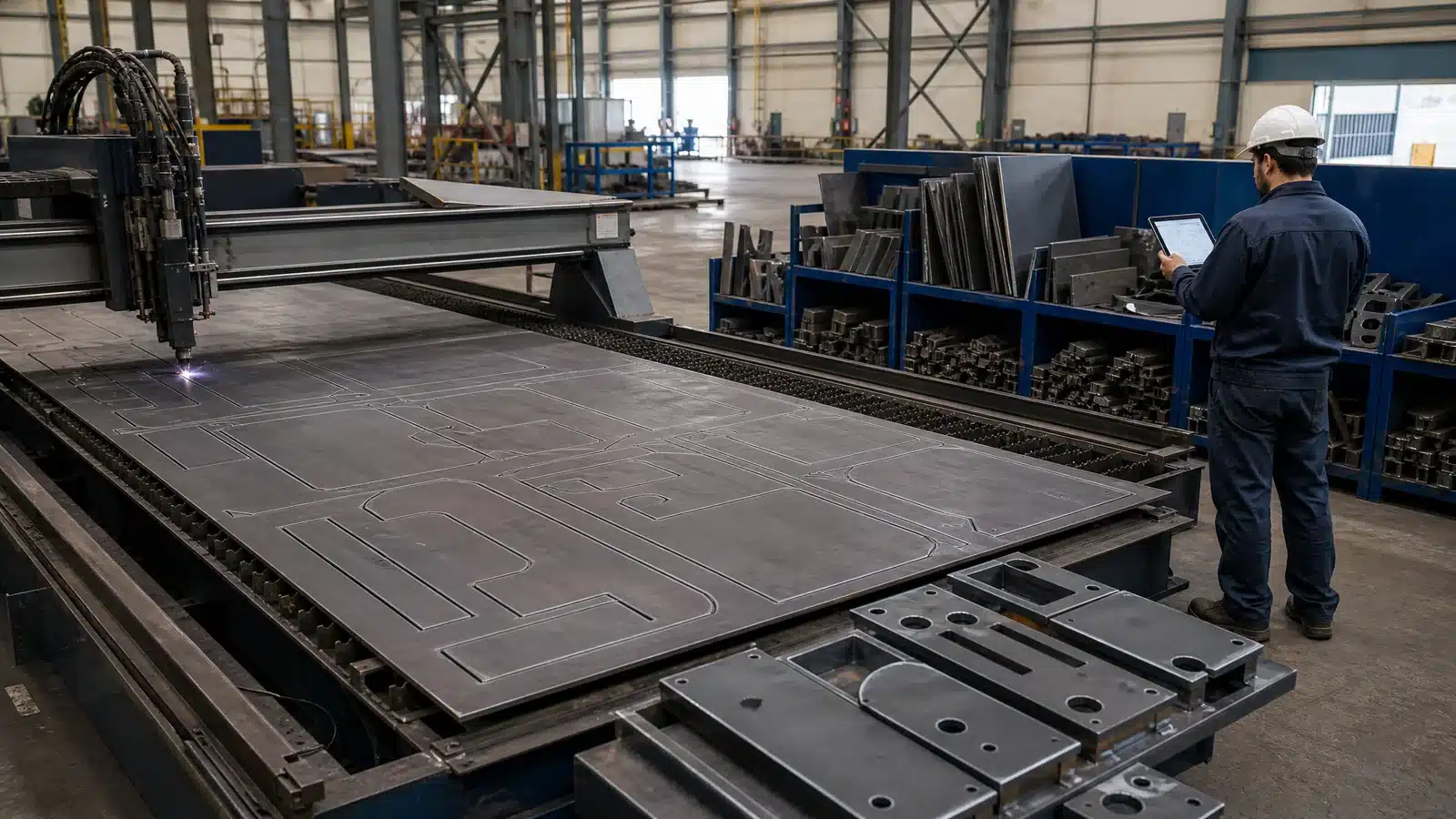
Nesting software can improve plate utilization, yet software alone does not guarantee a good result. The input must reflect the correct drawing revision, rolling direction where specified, edge quality, heat-treatment or forming requirements, weld preparation, inspection coupons, minimum bridges between parts and the capability of the selected cutting process.
A controlled nesting workflow normally includes:
- release only approved parts and revision levels;
- group parts by grade, thickness and traceability requirements;
- select available stock sizes before purchasing additional plate;
- review cutting sequence, thermal distortion risk and lifting practicality;
- approve the nesting plan before machine release;
- record actual output, remnants and deviations after cutting.
Common-line or bridge cutting may reduce travel distance and kerf in suitable cases, but it must be assessed against heat input, dimensional tolerance and part stability. Likewise, a narrower cutting kerf does not automatically make one process more economical: plate thickness, edge-quality requirements, cutting speed, secondary preparation and equipment capability all affect the decision.
Give reusable remnants a traceable identity
A remnant has value only if the factory can find it and prove what it is. Each reusable piece should retain or receive a durable identity showing the project or stock reference, material grade, heat or batch link, thickness, usable dimensions, date and storage location. If traceability is lost, the material may require additional verification or may be unsuitable for permanent work under the project requirements.
Remnants should be returned through a formal process rather than left beside the cutting machine. A searchable register allows planners to check existing stock before ordering new plate. Minimum reusable dimensions should be defined by the facility based on typical parts, handling cost and identification effort; there is no single threshold suitable for every fabricator.
Control errors that create avoidable scrap
Some material loss is inherent in converting standard stock into project-specific components. Avoidable scrap, however, often comes from management failures rather than geometry. Typical causes include obsolete drawings reaching the shop, incorrect material selection, mixed stock, wrong machine files, poor cutting sequence, handling damage, welding distortion and components fabricated outside tolerance.
The most useful improvement metric is therefore not a headline waste percentage by itself. Buyers and factory managers should review the cause of every abnormal loss and separate:
- planned geometric and process loss;
- design or revision-related loss;
- procurement and stock-selection loss;
- production nonconformance and rework;
- transport, storage or handling damage;
- unexplained inventory variance.
Corrective actions can then target the responsible interface instead of pressuring operators to report a lower number.
What steel buyers should ask for
During supplier evaluation or project kickoff, a buyer does not need access to every internal cost record. A focused evidence package is usually enough to judge whether material control is systematic:
- the project material-control procedure and responsibility matrix;
- a sample reconciliation from purchase receipt to accepted components;
- revision-controlled bills of materials and nesting reports;
- heat-number transfer and remnant-identification procedures;
- nonconformance and scrap classification records;
- periodic physical inventory reconciliation;
- evidence that substitutions require documented approval.
Any target waste allowance should be agreed only after reviewing the component mix, available stock sizes, cutting constraints, testing requirements and reporting boundary. A project dominated by repeated rectangular plates is not comparable with one containing tapered webs, curved components or complex connection plates.
Efficiency must remain inside the quality boundary
Material optimization must never compromise structural safety, contractual compliance or traceability. Required grade, thickness, section, toughness, through-thickness properties and inspection provisions remain governed by the approved design and project specification. Unidentified steel, unauthorized substitutions and undersized components are not efficiency improvements.
The strongest material-control system makes both cost and quality visible. It shows where every significant quantity of steel entered, where it was used, what remained reusable and why any abnormal loss occurred. That evidence helps buyers evaluate price credibility, helps fabricators protect margin and helps both parties reduce disputes during delivery.
If you are preparing a structural steel procurement package, Zhonghengfeng can review the material schedule, fabrication scope, documentation requirements and export-delivery interfaces during preliminary technical communication. Contact us with your drawings, specifications and target delivery plan.