
A Hengjiu Bridge company record published on November 30, 2020 focuses on a construction plan, an expert review meeting, and client feedback. Two available source-image captions identify an “expert review meeting site.” The accessible evidence does not clearly identify the project or customer, so this English account does not supply either name.
The operational value of expert review lies in converting a proposed method into a more testable and coordinated basis for site work. A construction plan must connect design information, temporary conditions, equipment, sequence, access, monitoring, inspection, and responsibilities. Review creates a point at which assumptions can be challenged before they become field constraints.
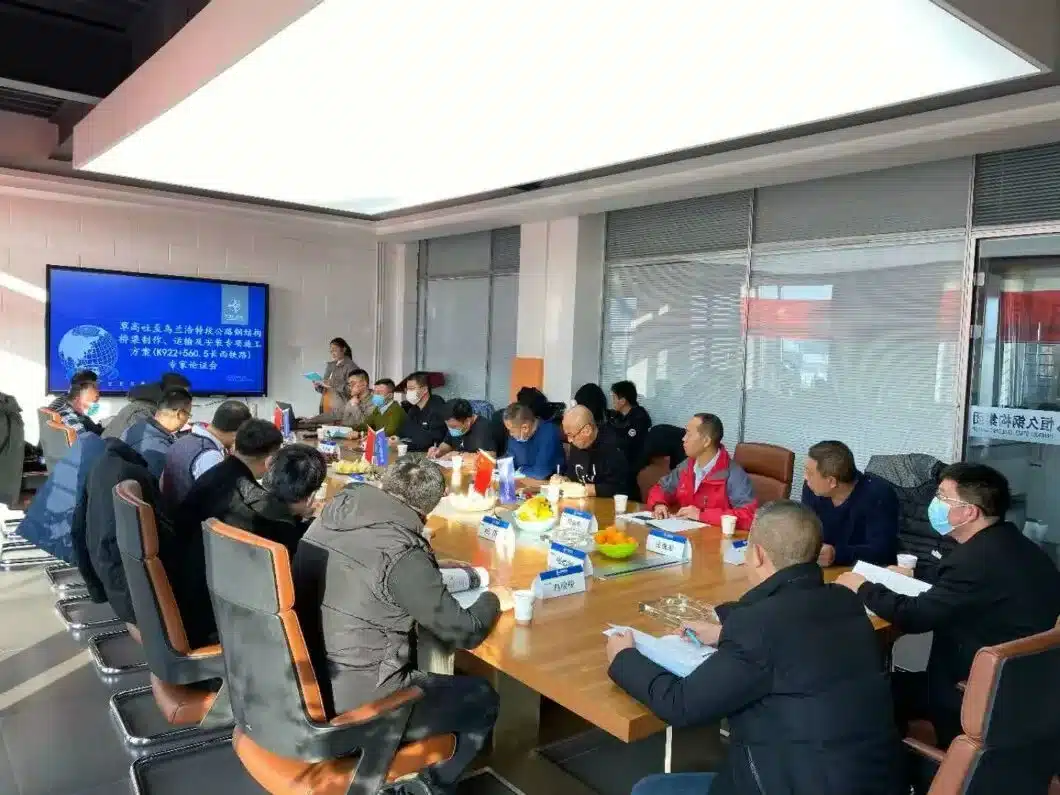
What an Expert Review Should Examine
An effective review is more than a presentation. The plan should give reviewers enough information to understand the structure or work package, the proposed sequence, the interfaces with existing conditions, and the controls for significant risks. Questions and required revisions should be captured so that the final issued plan is distinguishable from an earlier draft.
| Review area | Typical question | Expected output |
|---|---|---|
| Scope and basis | What work and design information does the plan cover? | Defined boundaries and references |
| Construction sequence | Are temporary and permanent states addressed in order? | Clear step-by-step method |
| Equipment and access | Can lifting, transport, assembly, and work access be executed as planned? | Verified arrangement and constraints |
| Stability and interfaces | How are temporary conditions and adjacent activities controlled? | Control measures and hold points |
| Inspection and monitoring | What must be checked before the next stage proceeds? | Acceptance points and records |
| Responsibilities | Who authorizes, executes, checks, and communicates changes? | Named functional ownership |
This table describes a general technical-review structure and is not a claim that the source listed each item. It is included to explain why the documented expert meeting is relevant to engineering and procurement audiences.
Close Comments Before Site Release
Review only adds value when comments are resolved. Each comment should have a response, an accountable function, and a disposition in the revised document. If the response changes equipment, sequence, temporary works, monitoring, or an interface with another contractor, affected parties need the updated information.
The issued version should be controlled at the point of work. Superseded copies should not remain in use, and field changes should follow an approved route. This protects the connection between the reviewed method and actual execution. It also helps the client or supervising party understand which plan is current.
From Plan to Site Control
- Brief the relevant teams on the approved sequence and constraints.
- Confirm that prerequisites are complete before each major stage.
- Identify inspection, witness, or hold points in advance.
- Record actual conditions that differ from the assumptions in the plan.
- Escalate changes for technical review instead of relying on informal adjustment.
- Retain completion and inspection evidence with the work package.
For bridge work, interfaces deserve particular attention because fabrication, transport, lifting, temporary support, alignment, connection, and site access may be managed by different parties. A good plan defines the contractor’s scope and does not attribute the entire project result to one participant.
Interpreting the Source-Reported Client Feedback
The original Chinese headline characterizes the outcome as a satisfactory response to the customer. In this revision, that phrase is treated only as source-reported feedback. The available record does not provide a named customer, a quotation, a signed letter, a score, or an acceptance certificate that would support a stronger independent claim.
That distinction is important for responsible company news. Feedback can indicate that the customer recognized the work described by the source, but it should not be converted into an unqualified guarantee or a claim about all project performance. Project-specific approval, acceptance, and completion remain subject to the applicable contract and records.
Engineering and Procurement Value
For an engineering team, expert review can expose incomplete assumptions and clarify temporary conditions before mobilization. For procurement, it provides evidence that a supplier or contractor can organize a technically reviewable method rather than offering only a general promise. Customers can ask to see the plan index, comment-closure status, revision record, and agreed hold points appropriate to the package.
Review timing should also be reflected in the procurement schedule. A technically complex plan may require input from designers, site management, equipment specialists, inspectors, and other contractors. Allowing time for review and revision is more realistic than treating approval as an instant administrative step.
Plan the Interface Early
The 2020 source supports a careful conclusion: Hengjiu Bridge reported using an expert review meeting to support a construction plan and reported positive customer feedback. It does not, in the evidence available for this draft, establish a project name, customer identity, quantitative performance, or universal outcome.
If you are preparing a bridge or structural-steel work package and want to discuss constructability, method review, fabrication-to-site interfaces, or documentation expectations, please contact us. Early technical coordination can help define the information and responsibilities needed for a workable plan.