
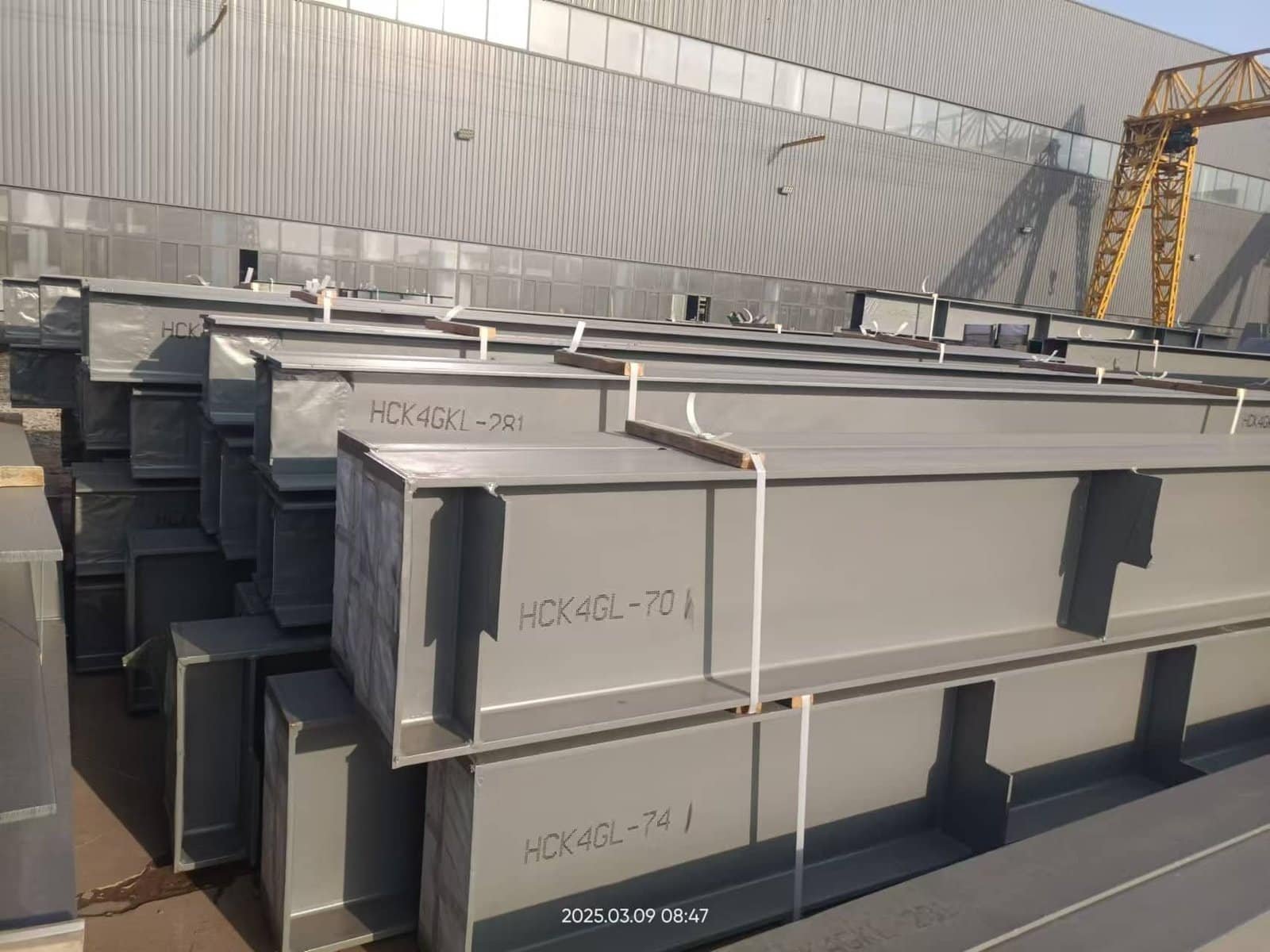
Marked steel beams stacked outside a workshop, with an original embedded date stamp.
Steel columns depend on the position and condition of the anchor bolts already embedded in the foundations. When the foundation contractor’s measurements and the fabricator’s shop drawings are not connected by a clear handover process, differences in position, elevation or exposed length may only emerge at site. Zhonghengfeng’s October 1, 2026 guidance sets out four interfaces to agree before the upper steelwork arrives.
Agree what the survey will check
The contract should identify checks for each anchor-bolt group: centre position relative to the structural axes, bolt-top elevation, exposed length and verticality. Foundation-top elevation can be included where necessary.
The Chinese source refers to the design documents and applicable Chinese national standards, including GB 50205, for permissible deviations; it supplies no numerical tolerances. This reference is specific to that source context and is not a statement that a Chinese standard governs every destination or project. The applicable project requirements must be confirmed separately.
Specify the information handed to the steelwork team
- Initial and repeat anchor-bolt survey records.
- An as-measured layout identifying each bolt group and its measured coordinates, elevations and exposed lengths.
- Handover records for the axis-control points and elevation benchmarks.
The foundation contractor or buyer-appointed party should provide signed paper records or traceable electronic records. The steelwork specialist uses this information to check column-base details and base-plate hole positions against the shop drawings.
Schedule the survey and require a signed handover
Place the handover survey before delivery of the upper steelwork and show it in the project’s delivery-milestone schedule. The foundation contractor or a survey organization appointed by the buyer carries out the measurements.
The source recommends participation by representatives of the buyer or supervising party, foundation contractor and steelwork specialist. If a separate erection contractor is involved, its attendance and interface should be expressly agreed. Signed records from the attending parties form the handover basis; the handover should not be assumed complete before sign-off.
Resolve deviations through the responsible parties
A deviation outside the agreed limits should be raised in writing and confirmed with the foundation party. Record the actual value and deviation against each bolt-group identifier, then obtain the parties’ sign-off on the deviation list.
The responsible party proposes a corrective arrangement for confirmation by the designer. The steel fabricator does not decide how the foundation is to be corrected. Within its agreed scope, it may revise shop drawings, including base-plate hole details, and fabrication to reflect the approved conclusion. Drawing revisions follow the agreed change process; commercial and schedule effects are addressed separately.
Distinguish foundation work from fabrication
Anchor-bolt embedment, correction and secondary grouting belong to the foundation contractor or other party named in the contract. They are not automatically part of the steel manufacturer’s work. Site erection responsibilities must also be defined separately.
This guidance concerns the steel fabrication and supply interface. The contract and technical agreement determine the actual responsibilities; it does not offer EPC general contracting or assume responsibility for site installation.
Zhonghengfeng Construction Group Co., Ltd. identifies its manufacturing and processing base as Baotou, Inner Mongolia, China. The company can discuss the relevant fabrication and supply interfaces with buyers, with the scope of any preliminary technical discussion agreed separately.
Archive source: Zhonghengfeng’s original Chinese company article, published 1 October 2026.