
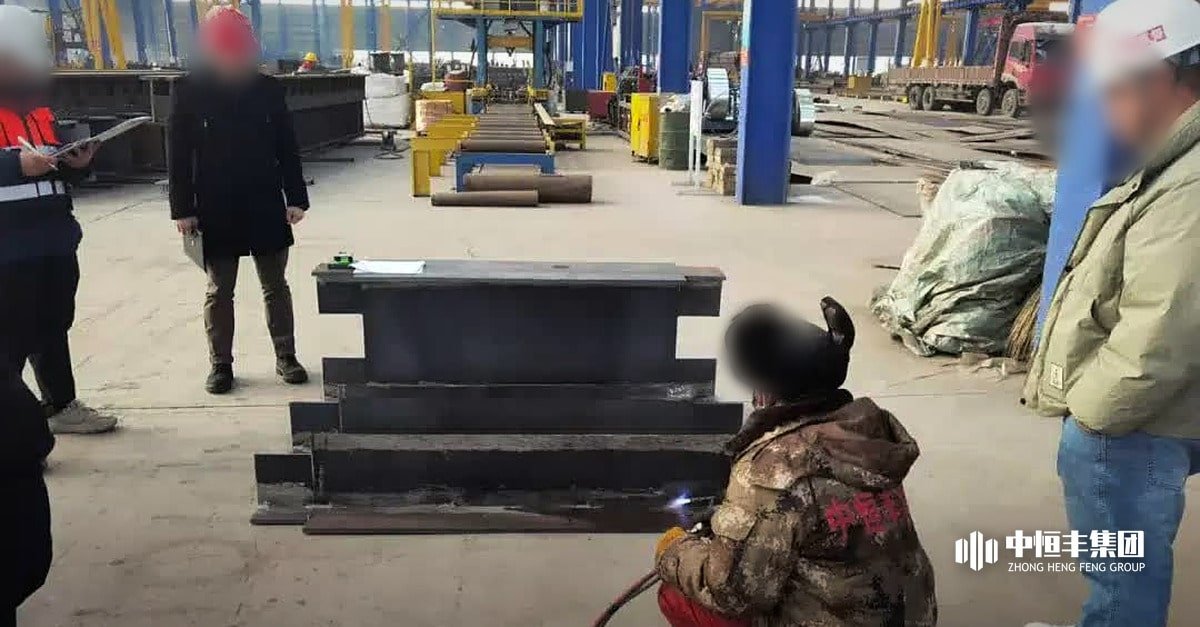
Ground-level welding activity in a steel workshop, with a Zhong Heng Feng Group watermark.
Steel erection creates changing work-at-height risks as beams, columns and floors are assembled. Narrow walking surfaces, open bays and incomplete permanent access require a protection plan before workers enter the area. Zhonghengfeng’s October 3, 2026 article discussed horizontal lifelines and safety nets for owners and construction teams. This English edition retains that planning focus while removing unverified installation prescriptions that could be mistaken for a complete, universally applicable system design.
Define the work and appoint qualified site responsibility
Identify the tasks, access routes, exposed edges and openings at each construction stage. Consider whether work can be completed from the ground or with a safer access arrangement before choosing fall-protection equipment. The approved plan should define how workers reach and leave the work area, including transitions between protected zones.
The appointed qualified local contractor must organize design coordination, installation, inspection and use under the applicable local requirements. Personal fall-protection systems and safety nets serve different functions; their required combination must follow the assessed risks and approved plan. Neither should be treated as permission to leave otherwise preventable exposure uncontrolled.
Specify a complete and compatible lifeline system
Select the approved system for the intended users, working positions and structure. Its anchors, supports, line, connectors, energy-management components and personal protective equipment must be compatible. Check the manufacturer’s permitted configuration, user capacity and operating limitations, together with the design of the supporting structure.
Assess fall clearance and possible contact with lower levels, obstacles or adjacent steelwork. The review must account for the actual system’s behavior, including line deflection and the applicable connecting equipment, rather than relying on nominal rope diameter or support spacing alone. Sharp edges, welding exposure and changing work positions also need appropriate controls.
An accessible structural member or connection is not automatically an approved attachment point. Ordinary bolts, purlins, lifting lugs and temporary pieces must not be presumed suitable. Any proposed attachment requires the necessary design and site approval before use; workshop provision of an ear plate does not itself certify the assembled fall-protection system.
Plan net coverage, supports and access
Safety nets should be selected for their intended protective function and the approved installation arrangement. Do not substitute a screening or debris-control product for a personnel-protection net without verification that it meets the required use. Confirm product identification, applicable conformity documents, support conditions, clearance and installation instructions.
Plan protection around open floor bays, openings and exposed perimeter areas as construction progresses. The approved arrangement must address coverage, connections, transitions and the space needed for the net to function. Changes or temporary removal require controlled authorization and suitable protection before the area is reopened for work.
Use current standards without inventing installation rules
For the Chinese standards context, the official SAMR record identifies GB 5725-2025, Fall Protection: Safety Nets as effective from September 1, 2026, replacing GB 5725-2009. The former edition should not be used as the current reference. SAMR also lists GB 38454-2019 for horizontal lifeline devices as current at this edition’s October 23, 2026 review.
This English edition does not reproduce the original support spacings, rope diameters, rope-clip count, line height or net tying-point spacing as universal installation rules. No exact dimensional clause is claimed here. Use the applicable current standards, approved system design and manufacturer instructions for the actual project. Chinese standards references do not establish compliance in another jurisdiction.
Inspect, control changes and prepare rescue
Complete the required pre-use inspection and acceptance before releasing the protected area. Users need instruction in the actual equipment and its limitations. Inspect at the specified intervals and after events requiring reassessment, including changes, damage or suspected fall loading. Remove affected equipment from service, identify it clearly and obtain the required assessment or replacement before further use.
Keep nets clear of accumulated debris using a safe procedure. Do not improvise repairs, cut netting or alter line tension and hardware outside the approved instructions. Rescue arrangements must be planned before work starts, with suitable equipment, trained personnel, communications and access. Calling for outside assistance alone does not demonstrate that a workable site rescue arrangement exists.
Coordinate approved details before fabrication
Within its agreed scope, Zhonghengfeng can coordinate approved reservation and connection details for items such as lifeline supports or net attachments during detailing and fabrication. The responsible designer and site contractor must confirm the requirements and interfaces. This support remains part of the detailing, fabrication and supply package; it does not transfer local installation responsibility or offer overseas installation contracting or EPC services.
This article is a planning reference, not a project-specific design, installation method or acceptance procedure. Protection must be ready and accepted before the relevant work begins.
Archive source: Zhonghengfeng’s original Chinese company article, published 3 October 2026. Technical wording clarified during English archive migration on 24 October 2026.