For structural steel buyers and fabricators, 2026 is less about one new rule than about several compliance systems becoming commercially important at the same time. Mandatory engineering requirements remain in force, China’s national emissions trading market now includes the steel industry, the European Union’s Carbon Border Adjustment Mechanism has entered its definitive phase, and owners increasingly expect digital quality records and verifiable environmental data.
The practical result is that technical compliance, carbon information and documentary evidence must be addressed before fabrication. A supplier may be capable of producing the components, but an international project can still be delayed if the applicable code editions, welding qualifications, inspection plan, carbon-data responsibilities or delivery records are not defined in the contract.
2026 compliance priorities at a glance
| Area | What has changed or matters in 2026 | Action before contract award |
|---|---|---|
| Mandatory engineering rules | Existing compulsory requirements continue to govern structural safety and project acceptance in China; 2026 is not their first effective year. | Identify the governing jurisdiction, code editions, design responsibility and acceptance criteria. |
| China’s carbon market | Steel, cement and aluminium smelting were brought into the national emissions trading market under the Ministry of Ecology and Environment’s 2025 work plan. | Ask upstream mills what verified emissions or product environmental information can be supplied. |
| EU CBAM | The definitive period began in 2026 for covered goods, with obligations centred on authorised EU importers and embedded-emissions data. | Confirm the CN code, importer responsibility, reporting boundary and required installation data. |
| Urban renewal and retrofit | China’s 2025 urban-renewal policy supports greater use and improvement of existing buildings and industrial areas. | Base retrofit pricing on surveys, assessment, access constraints and connection details rather than tonnage alone. |
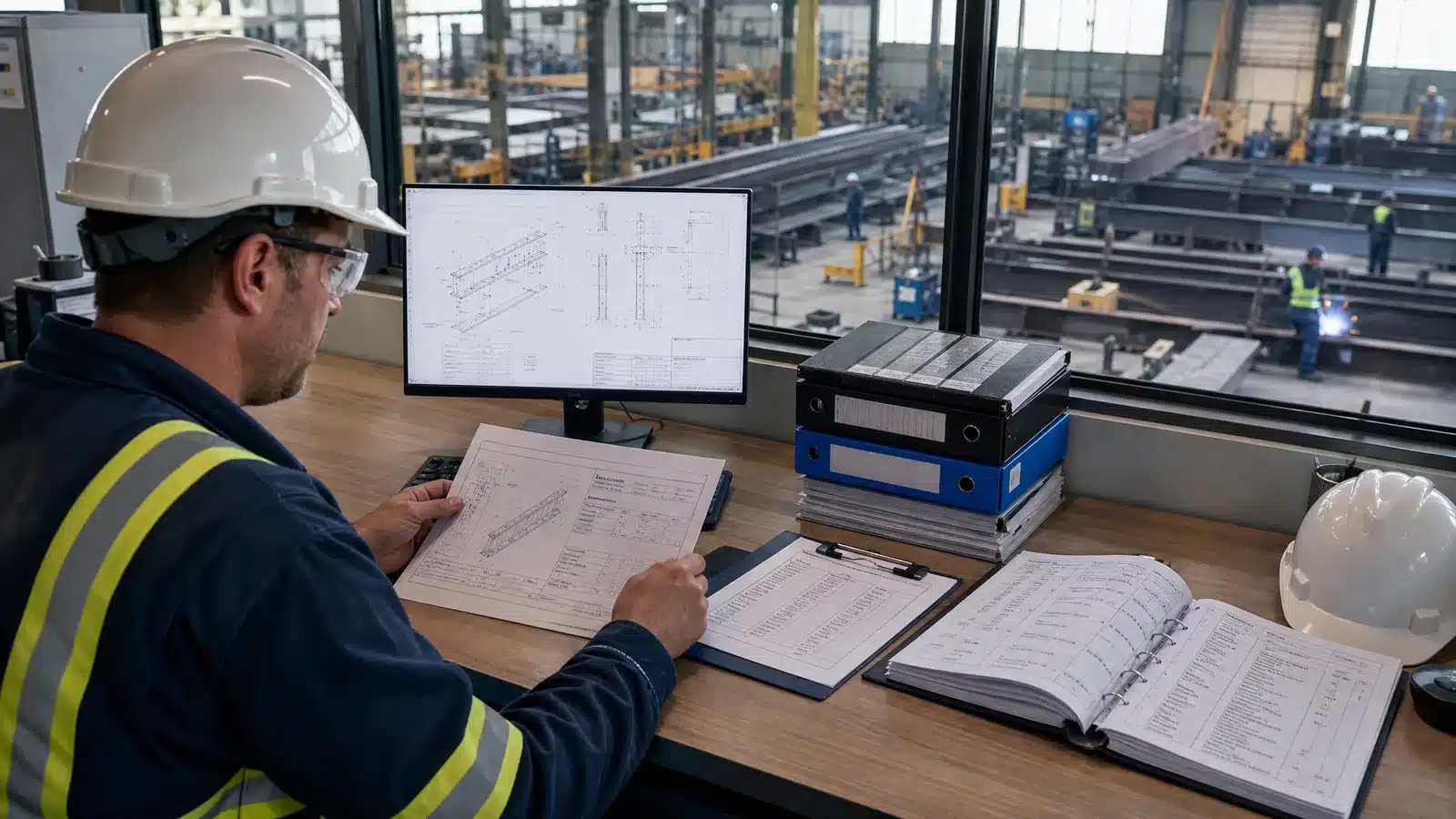
| Digital and traceable delivery | Owners and inspectors increasingly require records that connect materials, fabrication, inspection and shipment. | Agree the data book index, numbering rules, hold points and submission schedule before production. |
Mandatory steel rules are a baseline, not a 2026 trend
China’s GB 55006-2021, General Code for Steel Structures, took effect in 2022 as a mandatory engineering construction code. It should therefore not be presented as a rule newly introduced in 2026. Its commercial relevance in 2026 is that buyers, designers, detailers, fabricators and contractors need to translate the governing requirements into project-specific drawings, procedures and acceptance records.
A broad instruction such as “comply with Chinese standards” is not enough for procurement. The technical package should identify:
- the design basis and responsible design party;
- material grades, product standards and required certificates;
- connection-design and shop-detailing responsibility;
- welding code, WPS/PQR requirements and welder qualifications;
- NDT methods, extent, acceptance criteria and reporting format;
- dimensional tolerances, trial assembly and release points;
- coating or fire-protection scope and acceptance requirements.
International projects may instead be governed by AISC/AWS, EN 1090 and related European standards, GOST requirements or a project-specific combination. These systems are not interchangeable. The contract must state which requirement governs where standards conflict, and whether substitutions or equivalency proposals require written approval.
China’s carbon market changes the upstream steel conversation
In March 2025, China’s Ministry of Ecology and Environment issued the work plan bringing steel, cement and aluminium smelting into the national carbon emissions trading market. This is an upstream development for most structural fabricators: the regulated installation is generally the steel producer, not every company that cuts and welds purchased steel.
However, upstream carbon management can influence purchasing decisions and the environmental information available to downstream projects. Structural steel buyers may increasingly ask for mill-specific data, an environmental product declaration, process-route information or other verified evidence rather than a generic industry average.
Fabricators should avoid converting this policy into an unsupported promise about future steel prices or project carbon savings. Carbon cost pass-through depends on the supplier, product, allocation rules, contracts and market conditions. The reliable procurement action is to define the data required from the mill and keep it linked to the material certificates and project batch.
CBAM requires data coordination, not a slogan
The EU Carbon Border Adjustment Mechanism moved from its transitional reporting phase into the definitive regime in 2026. For covered imports, the legal declarant is on the EU side. A non-EU steel fabricator nevertheless becomes an important data provider because the importer may need installation and embedded-emissions information.
Not every fabricated steel item is automatically treated the same way. Applicability depends on the customs classification, origin, transaction and current CBAM rules. Before quoting an EU-bound project, the parties should confirm:
- the relevant CN code for each product or shipment line;
- whether the goods fall within the current CBAM scope;
- which EU entity acts as importer and authorised declarant;
- which production installation and precursor data are required;
- the monitoring methodology, verification expectations and submission timetable;
- how incomplete data, changes in classification or additional verification costs are handled commercially.
A steel fabricator should not claim that all welding electricity, coating emissions, packaging and transport are automatically included in every CBAM calculation. The applicable boundary is determined by the current regulation, implementing rules, product classification and methodology. Project lifecycle carbon accounting is a separate exercise and may have a broader boundary.
For buyers, the safest contract approach is to attach a carbon-data schedule instead of using a general phrase such as “supplier to support CBAM.” The schedule can state required fields, responsible parties, source documents, review dates, confidentiality treatment and consequences of late or unverifiable information.
Urban renewal creates opportunity but changes the pricing basis
China’s 2025 policy on sustained urban-renewal action includes the improvement and reuse of existing buildings, old industrial areas and other urban assets. Steel structures can be useful in retrofit projects because prefabricated members may reduce wet work and can offer a favourable strength-to-weight ratio. These advantages are project-dependent, not automatic.
Retrofit work often carries more uncertainty than new construction. Existing drawings may be incomplete, actual dimensions may differ from records, access for cranes or transport may be restricted, and new connections must transfer forces into an existing structure whose condition has to be assessed.
For that reason, retrofit quotations should identify survey and investigation assumptions, temporary works, shutdown windows, protection of existing operations, hidden-condition risk and the approval process for discoveries on site. A simple price per tonne can be misleading when access, sequencing and connection work dominate cost.
Digital delivery should connect evidence to the component
Digital construction is often discussed in terms of BIM platforms, robots or factory automation. For a buyer, the more immediate test is whether project data remain consistent from design through delivery.
A useful digital chain connects the approved model or drawing revision to the bill of materials, material heat, component number, welding and inspection records, coating report, packing list and shipment. Technology can support this chain, but software does not replace document control or engineering approval.
Before fabrication, the buyer and supplier should agree:
- a single component and document numbering convention;
- the controlled method for issuing and cancelling revisions;
- inspection hold, witness and review points;
- the required record for each manufacturing stage;
- the data-book index and progressive submission dates;
- the format for final handover and later retrieval.
This turns traceability into a production output rather than a document-recovery exercise after shipment.
Build compliance into the quotation checklist
The most useful response to regulatory change is a responsibility matrix attached to the inquiry or contract. It should separate design, fabrication, inspection, customs and environmental obligations and identify the evidence required for each one.
| Question | Required answer |
|---|---|
| What governs the work? | Jurisdiction, code editions, project specification and order of precedence |
| Who owns technical decisions? | Design, connection design, detailing, substitution and approval responsibilities |
| How is quality released? | ITP, hold points, inspection authority, acceptance criteria and report format |
| What environmental data are needed? | Product scope, calculation boundary, methodology, verification and deadline |
| What must accompany the shipment? | Certificates, packing lists, inspection records, traceability data and customs documents |
What overseas steel buyers should take from 2026
The central change is not that every rule became new in 2026. It is that compliance evidence now affects supplier qualification, pricing, customs preparation and release for shipment more directly. Buyers should be cautious of articles or quotations that turn complex regulations into fixed cost percentages, universal carbon claims or one-line certification promises.
Use official sources and the latest project documents for final decisions. The Ministry of Ecology and Environment’s official notice confirms the 2025 expansion of China’s national carbon market to steel, cement and aluminium smelting. The applicable EU CBAM rules and guidance should be checked against the European Commission’s current information and the specific customs classification. Engineering compliance remains governed by the project jurisdiction, approved design and contract.
Zhonghengfeng supports preliminary coordination for structural steel engineering, detailing, fabrication, quality documentation and export delivery. To discuss the standards, inspection plan and documentation package for your project, contact us with your drawings, specifications, project location and intended delivery scope.