
Li Tao | Steel Structure Expert, China
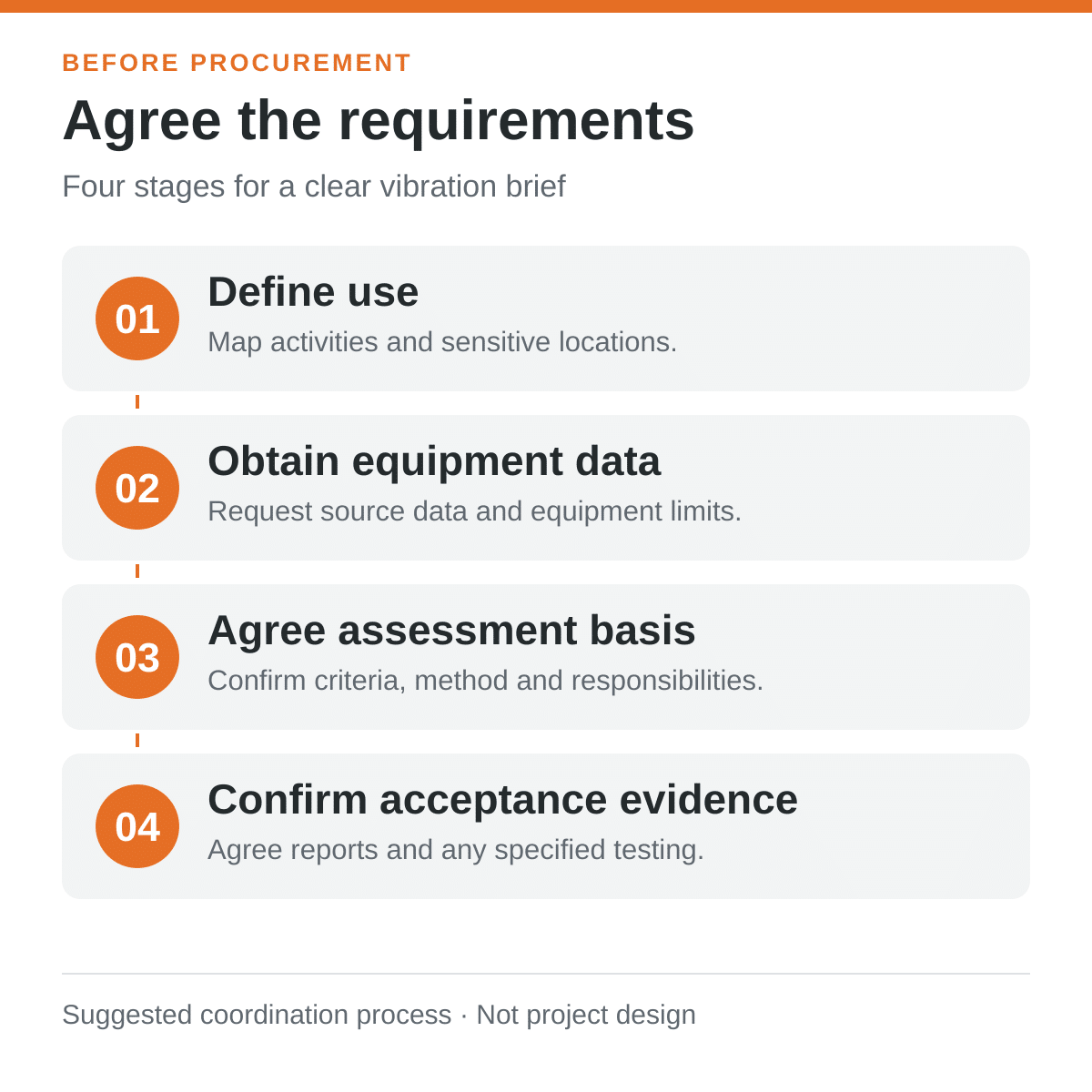
Before ordering an industrial mezzanine or a multi-storey steel floor, agree how vibration performance will be assessed for its intended use. Identify the activities and equipment, the locations that need protection, the applicable acceptance criteria and the party responsible for the assessment. Put those decisions into the enquiry package before comparing alternative steelwork prices.
A floor load rating is useful, but it does not describe every condition that matters to a production line, a quiet office above a warehouse or a precision measuring station. Steel floor vibration requirements connect those operating needs to the structural design and to the completed floor that the buyer will actually use.
This article proposes a buyer-side coordination process. It does not select structural members, vibration limits or isolation equipment. The responsible engineers and relevant specialists should establish the technical requirements under the project’s governing documents and local approval arrangements.
Why a floor load rating does not settle vibration performance
Can a floor that meets its strength and static deflection requirements still need a separate vibration assessment? Yes. A load rating describes specified loading conditions; it does not, by itself, establish the response to repeated movement or the tolerance of a nearby instrument.
AISC research treats occupant-induced floor vibration as a serviceability concern that can affect the intended use of a building. Guidance for human activity should not be treated as a complete machinery design specification. The project engineer needs to determine the assessment appropriate to the source and the intended use. [1, 4]
The buyer should therefore ask for the vibration design basis as a named deliverable when it is relevant to the project. An answer such as “the beams meet the required live load” leaves the dynamic question unresolved. Perceptible movement warrants investigation; observation alone does not determine structural safety or compliance with the agreed requirements.
Separate the purchasing questions. What loads must the floor support? What movements can users and equipment tolerate? What evidence will show that both requirements have been addressed? Recording these separately helps prevent a strength calculation from being presented as the whole answer.
Describe the actual use of every relevant floor zone
Prepare a marked-up plan with the owner’s operations team and equipment suppliers. Identify the area used for packing, pedestrian circulation, offices, machinery and any sensitive process. Include adjacent areas that could be affected, rather than considering only the footprint of a machine. ASI guidance likewise recommends establishing acceptable vibration with the anticipated use and layout in mind. [8]
Avoid describing an entire floor simply as “industrial use.” A packing platform with intermittent movement and an inspection station can have different requirements even when they occupy the same building. If the final tenant or machine has not been selected, state the unresolved use explicitly and identify the design assumptions that may need revisiting.
The following is a suggested information schedule. The project engineer should decide which entries are needed and the required level of detail.
| Input | Evidence to request | Party to confirm |
|---|---|---|
| Intended use and layout | Dated plan showing activities, circulation and sensitive locations | Owner and operations team |
| Machinery that generates vibration | Vendor’s support layout, operating conditions and available dynamic force information | Equipment supplier with project engineer |
| Equipment sensitive to vibration | Manufacturer’s acceptance limits, measurement basis and point of application | Equipment supplier and relevant specialist |
| Floor system | Coordinated framing, slab or deck details, connections and assumed construction condition | Responsible structural engineer |
| Future use | Defined future equipment or an explicit limit on the uses assessed | Owner and responsible engineer |
| Acceptance evidence | Assessment scope and any agreed field testing requirements | Buyer, engineer and appointed testing party |
Where machinery is involved, its weight and nominal speed may be insufficient inputs. Ask the equipment supplier what operating modes, speed range, start-up or shutdown conditions and transmitted actions the designer needs. The buyer’s role is to obtain the right source information and resolve missing items, not to calculate a generic dynamic multiplier.
For future expansion, use a defined scenario. “Suitable for any future machine” is too broad to price or verify. A documented restriction can be more useful than an unexplained allowance that appears to cover every future use.
Turn the requirement into a measurable acceptance basis
Which vibration limit should a steel mezzanine meet? The project-specific limit selected for its use, source and evaluation method. Copying a number from another building can create a requirement that is either inadequate or unnecessarily restrictive.
For people, the assessment concerns the response associated with the intended activity and occupancy. For sensitive equipment, obtain the manufacturer’s stated tolerance. Published AISC research distinguishes equipment criteria expressed in peak acceleration from criteria expressed as acceleration or velocity across frequency bands. These descriptions cannot be compared as if they were the same measurement. [2]
Ask the responsible specialist to record the metric, units, direction, frequency range or weighting, observation period and measurement location needed to interpret the limit. If a vendor supplies a vibration curve without its measurement convention, seek clarification before inserting it into a steelwork specification.
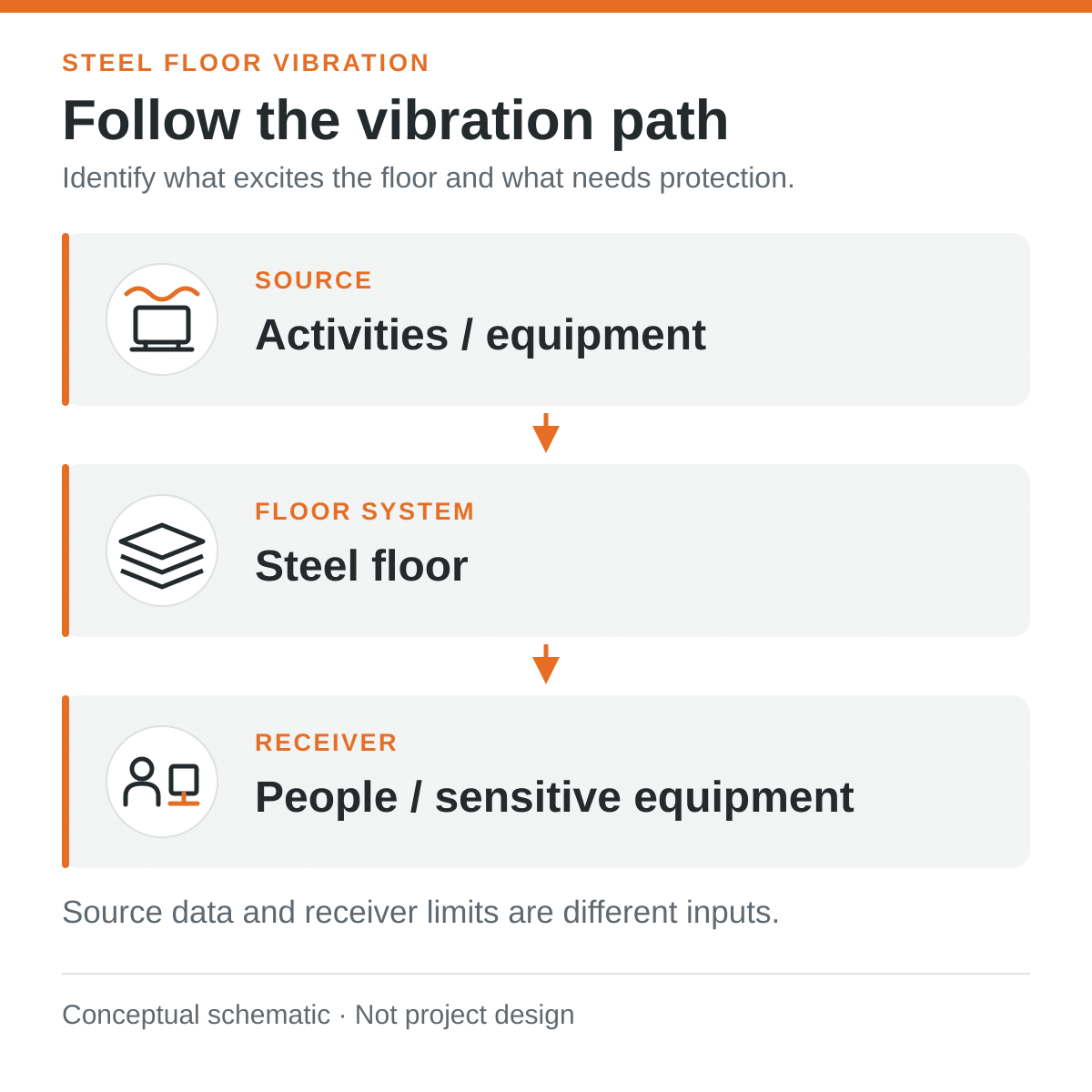
Also distinguish the source from the receiver. One machine can generate vibration while a different machine, workstation or adjoining space is sensitive to it. The evidence needs to address that relationship. A successful check at the source does not automatically establish acceptable conditions everywhere else.
A natural-frequency value can be part of an assessment, but it should not be accepted as a universal performance certificate. SCI’s floor-vibration guidance evaluates response and acceptance in addition to frequency. Ask the engineer to explain why the chosen method suits this floor, rather than requiring the buyer to interpret an isolated model image or frequency result. [3]
Confirm the governing basis for the destination
For a United States project, ask the responsible engineer to identify the adopted building code, applicable AISC provisions and project-specific serviceability criteria. A published guide can support an assessment without becoming a universal acceptance requirement for every project. Record the edition actually used and any contract requirements that supplement it. [6]
For Canada, confirm the province or territory, applicable building code and the standards referenced by the project. NRC’s Structural Commentaries for NBC 2020, published in 2025, include guidance on floor vibration, but the publication describes its commentary as non-mandatory. Do not turn a guidance example into a blanket contractual limit. [4, 7]
For Australia, identify the state or territory and the NCC edition applicable to the work. Adoption dates can differ. For example, Queensland’s official guidance states that NCC 2022 continues until its announced commencement of NCC 2025 on 1 May 2027. The local engineer should confirm the applicable design standards and vibration criteria for the actual project. [5]
For a United Kingdom project, identify the UK nation, relevant approval route and agreed standards. SCI P354 and the associated UK industry guidance can inform floor-vibration assessment, but this does not establish a single legal acceptance rule for every UK project. Nor should a UK design brief be labelled “European compliance”: projects in Germany, France or another European country need their own national and project checks. [3]
These checks define the design basis. They do not demonstrate that a particular overseas supplier holds a certification, has local engineering authority or has secured project approval.
Compare alternative quotations on the same performance basis
A lower steel tonnage is meaningful only when the alternatives address the same agreed requirements. Ask each bidder to identify which drawings, intended uses and assessment assumptions support its offer, and whether the quoted scope includes a vibration assessment or only fabrication to supplied details.
If a bidder changes the beam arrangement, floor build-up, connections or supported equipment position, request the responsible engineer’s review of the revised performance basis. Do not accept a statement that the alternative has “equivalent strength” as evidence that every serviceability condition remains unchanged.
A useful assessment submission identifies the zones and operating scenarios checked, the input revisions, the modelling assumptions relevant to the result, the criteria applied and any limitations. Where the assessment relies on partitions, fit-out, stored goods or other features, ask whether those conditions will actually exist during the relevant use and whether the owner may later remove them.
The steelwork price should distinguish confirmed scope from unresolved work. If isolation equipment or specialist testing is excluded, identify the party procuring it and the information that must reach the steel detailing team. An exclusion should lead to an assigned interface, rather than a gap that all suppliers assume someone else will close.
For the broader commercial and technical enquiry, use the steel structure quotation checklist. Keep the vibration schedule as a focused attachment to that package, with its own revision and responsible reviewer.
Separate fabrication evidence from completed floor acceptance
Can factory inspection prove that the installed floor will meet its vibration requirement? Factory records can verify supplied steelwork against its approved requirements, but they cannot alone verify the response of the complete installed floor. The final system may include slabs, connections, supports, equipment and finishes completed by other parties.
Before ordering, agree who owns each deliverable. A suggested allocation, subject to the project contracts, is as follows. The owner defines the operational needs. Equipment vendors provide their interface data and relevant tolerances. The responsible engineer evaluates the structural system and resolves the technical basis. The fabricator works to the agreed documents and supplies the specified fabrication evidence. Appointed local contractors complete their installation scope, and the designated specialist undertakes any agreed testing.
The handover record should identify the details that the assessment depends on and the parties responsible for completing them. Relevant examples may include the floor build-up, connection details, equipment support arrangement and any specified isolation interface. The engineer should determine the significance of a departure; the purchasing team should ensure that the departure is not hidden by a general completion statement.
This allocation should also distinguish overseas installation technical guidance from installation contracting, local design approval and specialist performance testing. Buying supplied steelwork with technical guidance does not silently transfer all of those responsibilities to the manufacturer.
Agree the acceptance test before a dispute arises
Where field testing is specified, agree its purpose and conditions before procurement is closed. Testing that identifies a floor’s dynamic properties and testing that measures its response during a defined activity answer different questions. The protocol should match the acceptance decision the project intends to make. [3]
Request a test scope stating the floor’s completion condition, relevant equipment operation, measurement locations, instruments and calibration evidence, evaluation method, reporting format and acceptance authority. Have the specialist specify the technical details rather than filling them with generic values from a purchasing template.
Define how early observations will be handled if the floor is tested before the intended fit-out or machinery is complete. Record what can be accepted at that stage and what remains to be checked. This avoids treating a preliminary test as final acceptance, or treating a result from a different operating condition as an automatic failure.
The contract should also state who investigates an unexpected result and how approved changes will be documented. A buyer should not authorize ad hoc stiffening, added mass or isolation changes on the assumption that more material will necessarily solve the problem. The proposed remedy needs an engineering assessment of its wider effects.
A late machine selection can change the purchase basis
Consider a hypothetical warehouse mezzanine initially specified for packing and pedestrian access. After steelwork pricing, the owner selects a machine with cyclic operation and places a measuring station nearby. The machine’s static weight fits the stated floor load allowance, so the commercial team assumes no further review is required.
The useful next step is to reopen the relevant input schedule. Obtain the machine’s operating and support information, the measuring station’s vibration tolerance and the revised layout. Ask the responsible engineer whether the existing assessment covers the new arrangement and what must change if it does not. Record any effect on steelwork, other packages, cost and programme before releasing affected details.
This example is a coordination scenario, not a report of a Zhonghengfeng project. Its lesson is that a change in use should be checked against the performance basis actually purchased, even when the headline floor load appears unchanged.
What to send with the enquiry
For a steel floor package where vibration matters, provide the project location, coordinated framing and floor-system information, a marked-up use plan, available equipment data and the engineer’s performance requirements. Identify missing information, the party expected to supply it and the point at which it must be resolved.
Ask the proposed supplier to state its scope and exclusions against those inputs. Before approving the order, confirm who will complete any specialist assessment and acceptance testing, and how subsequent changes in equipment or use will be reviewed.
Zhonghengfeng’s overseas supply scope is engineering coordination, detailing, factory fabrication, export delivery and agreed remote or on-site installation technical guidance. It does not include overseas EPC or installation contracting. Share the relevant project information so the supply scope and unresolved interfaces can be reviewed; project-specific engineering, local approvals and testing responsibilities should be assigned explicitly.
Sources and further reading
Sources checked on 3 November 2026. The information schedule, suggested allocation of responsibilities and hypothetical scenario above are original buyer-side coordination recommendations, not universal code requirements. Confirm applicable editions and requirements for the specific project.
- AISC Engineering Journal. Design Aids for Walking Vibrations in Steel Framed Floors (1999). Public abstract and publication details; occupant-induced vibration research.
- AISC Engineering Journal. Walking-Induced Vibration of Steel-Framed Floors Supporting Sensitive Equipment (2019). Public abstract; equipment vibration metrics for walking-induced response.
- Steel Construction Institute. SCI P354: Design of Floors for Vibration (revised 2009). Technical guidance, including sensitive equipment and dynamic testing; not a universal statutory criterion.
- National Research Council Canada. Structural Commentaries for NBC 2020 (published 2025). Non-mandatory commentary; see Commentary D for deflection and vibration considerations.
- Queensland Government. Delayed adoption of the National Construction Code 2025. Queensland adoption timing, checked 3 November 2026; confirm the current project-specific requirements.
- NIST. Understanding Building Codes. US state and local adoption context.
- National Research Council Canada. Canada’s construction system. Background on provincial and territorial adoption; not evidence of the edition currently applicable to a project.
- Australian Steel Institute. Design Aspects. Industry guidance supporting early, use-based vibration criteria.