
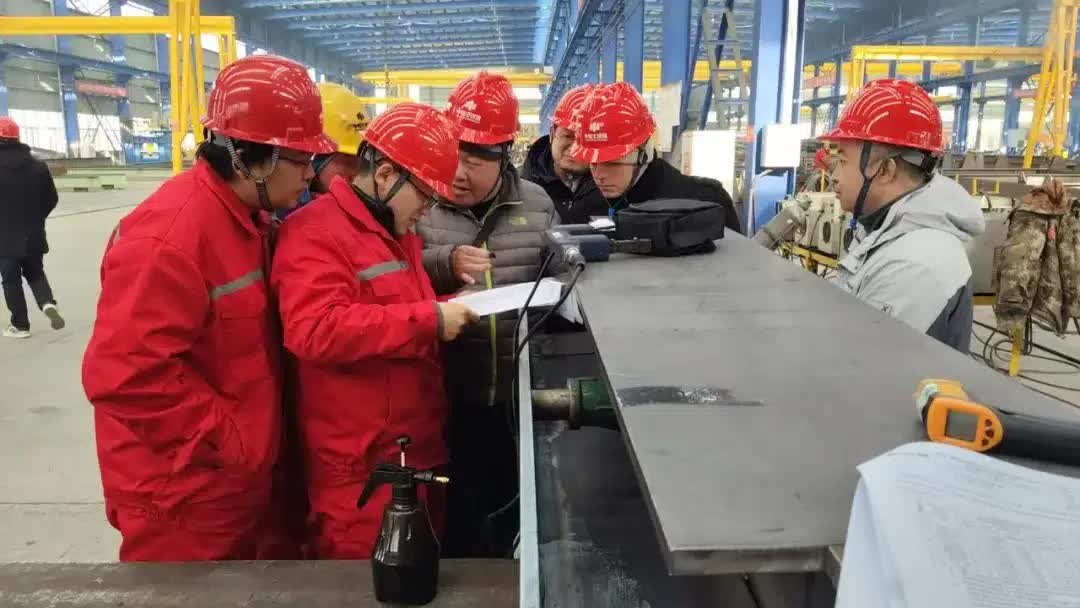
Personnel examining paperwork beside a steel component on the workshop floor.
A claim of reliable quality becomes useful when it can be checked against documents and traceable component identifiers. Zhonghengfeng’s September 25, 2026 guidance proposes ten categories for a fabrication quality dossier, with the final requirements determined by the contract and technical conditions.
Connect material identity to the delivered components
- Material quality certificates: confirm that plate and section heat or batch numbers, material designation, mechanical properties and chemical composition correspond with the order. Agree incoming retesting or independent retest reports where necessary.
- Material lists and tracking records: connect heat or batch numbers with component marks and cutting batches so that material remains traceable after processing.
Keep welding and inspection evidence specific
- Welding procedures and welder qualifications, as required by the contract: verify the applicability of welding procedure specifications and qualification records, and the coverage of the welder’s qualified work and actual welding position.
- Weld inspection records: retain visual-inspection records, specified nondestructive-testing reports and the documented closure of nonconforming work.
- NDT scope and conclusions: state the examination extent, inspection timing and acceptance basis. A standalone “passed” statement without the supporting scope is insufficient.
Include dimensional, coating and dispatch records
- Dimensional and hole-making records: retain actual measurements for first articles or critical components, including relevant length, hole spacing and end-milling checks.
- Surface-preparation and coating records: identify the preparation grade, cleanliness, dry-film thickness and coating-material batch; retain rework records where applicable.
- Factory inspection, conformity records and packing lists: reconcile member marks, the required certificates and reports, and the shipping list so that receipt can be checked component by component.
- Trial-assembly records or photographs, where required: retain checks for complex connections or components subject to special size constraints before dispatch.
- Supporting evidence of systems or capability: copies of relevant manufacturing licences or certifications may supplement the dossier, but do not replace material traceability or weld-inspection reports.
Agree the dossier index and release conditions in advance
Make the agreed document list a contract appendix. Identify what happens when an item is missing: whether the record must be supplied before release, whether the affected work is held, or whether an authorized concession is permitted. The applicable contract and approval process govern the decision.
The dossier records evidence at the agreed delivery milestones. It is separate from the milestone schedule itself and from the ITP’s selection of hold points. Certificates are supporting evidence, not proof that every supplied component has passed the required checks.
Keep site records within the correct contract scope
Final tightening of site high-strength bolts, field-weld testing and installation acceptance records should be assigned separately when they belong to the installation or main-contract interface. They should not automatically become obligations within the factory’s dispatch dossier.
This guidance concerns the steel fabrication and supply interface. The contract and technical agreement determine the actual responsibilities; it does not offer EPC general contracting or assume responsibility for site installation.
Zhonghengfeng Construction Group Co., Ltd. identifies its manufacturing and processing base as Baotou, Inner Mongolia, China. The company can discuss the relevant fabrication and supply interfaces with buyers, with the scope of any preliminary technical discussion agreed separately.
Archive source: Zhonghengfeng’s original Chinese company article, published 25 September 2026.