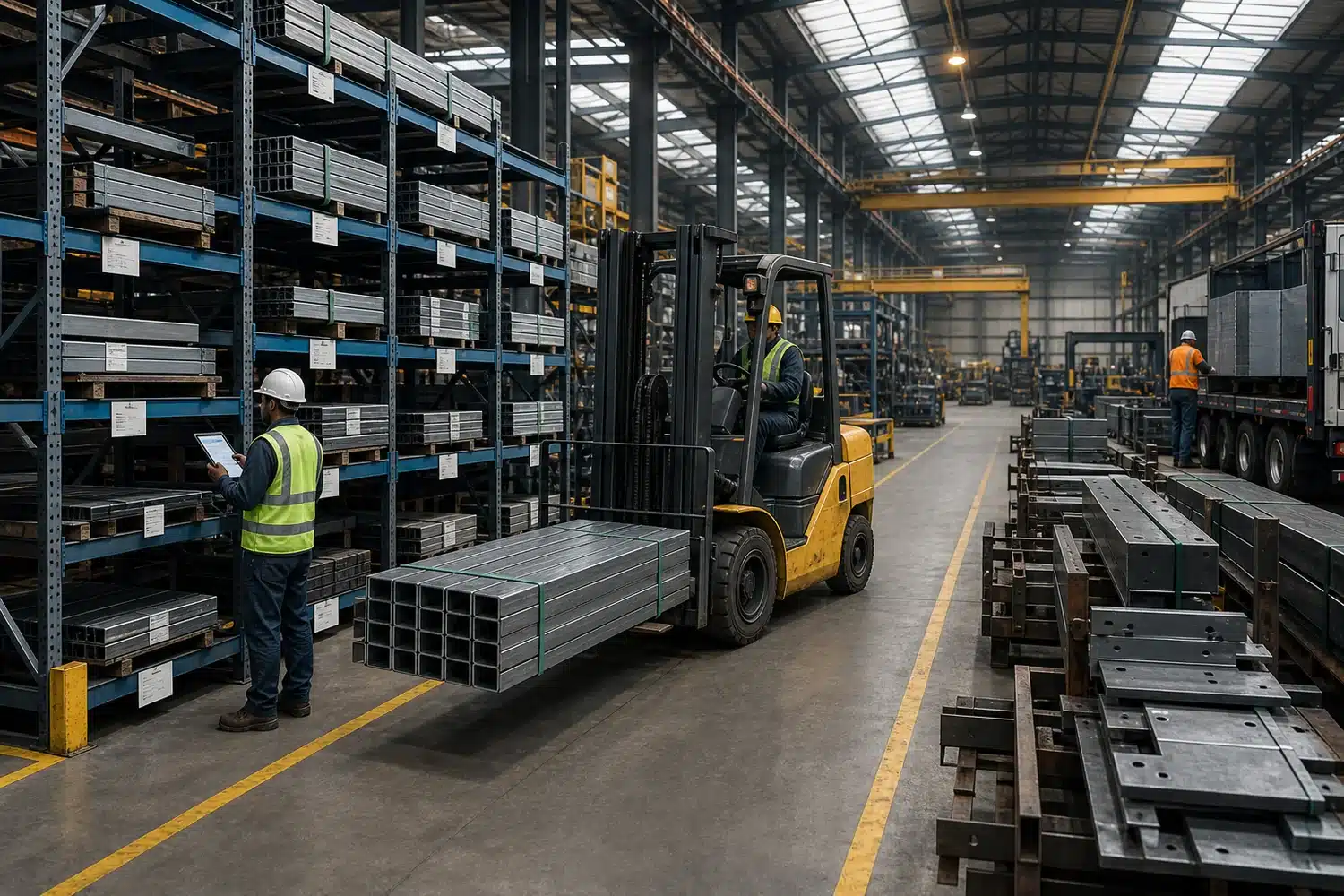
Steel fabrication is visible on the workshop floor, but its continuity also depends on work that happens between production planning, material storage, internal transport, document control, and the point of use. The original company record published on January 26, 2021 identifies its central subject as logistics support and materials services. This revised account keeps that operational focus and removes the personality-led language of the original headline.
The practical issue is straightforward: a production team can only act on a plan when the specified material, consumables, tools, and supporting information are available at the required location and time. Logistics support therefore should not be treated as a collection of isolated errands. It is a controlled service flow with inputs, handoffs, records, and feedback.
From a Production Need to a Service Request
A useful materials-service process starts with a clear request. The request should identify the work order or production area, the item required, the relevant specification, the quantity, the requested time, and the receiving point. If one of these elements is unclear, the support team needs a defined route for clarification before material is moved.
This first step matters to engineering and procurement teams because ambiguity travels downstream. An unclear grade, drawing reference, or delivery point can create avoidable handling, waiting, or rechecking. A structured request gives each function a common reference and helps distinguish a genuine priority from an informal interruption.
A Practical Control Chain
| Workflow stage | Control question | Useful record |
|---|---|---|
| Request | What is needed, where, and by when? | Material or service request |
| Verification | Does the item match the specification and current plan? | Drawing, bill-of-material reference, or approved list |
| Allocation | Is the requested stock identified and reserved? | Stock or reservation entry |
| Issue | What quantity was released and to whom? | Issue record |
| Internal delivery | Has the material reached the correct point of use? | Transfer or receipt confirmation |
| Feedback | Was there a shortage, mismatch, damage, or schedule change? | Exception and closure note |
The table describes a generally applicable control logic rather than claiming that every listed document appeared in the source article. Its value is to show how the source theme can be translated into a transparent workflow for industrial buyers and project teams.
Protecting Traceability During Internal Movement
Internal movement is not merely transportation. Material identity must remain connected to its intended use. Labels, heat or batch references where applicable, quantities, destination, and receiving responsibility should remain readable through storage, staging, and workshop delivery. When material is split, returned, or reassigned, the corresponding record needs to follow the physical change.
Good housekeeping at storage and staging points supports this control. Defined locations, separation of accepted and nonconforming items, protected storage for sensitive consumables, and clear routes for lifting or vehicle movement reduce uncertainty. These are process disciplines, not claims of a particular certification or performance level.
Managing Exceptions Without Disrupting Production
Normal flow is only part of the job. Production conditions change. A drawing may be revised, a sequence may move, a quantity may be adjusted, or an item may require reinspection. The support process needs a visible exception route rather than an undocumented workaround.
- Confirm the latest approved requirement before substituting any item.
- Record shortages and mismatches against the relevant request.
- Separate questionable or damaged material pending disposition.
- Communicate revised timing to planning and the receiving workshop area.
- Close the exception only after the physical item and the record agree.
For procurement, this feedback can improve replenishment decisions and supplier communication. For engineering, it can reveal where specifications or revisions need clearer release control. For production, it provides a more reliable basis for sequencing work.
Value for Engineering and Procurement Teams
A controlled support workflow helps buyers evaluate more than nominal manufacturing capacity. It points to the supplier’s ability to coordinate information and material across functions. During supplier discussions, customers can ask how requests are authorized, how material identity is preserved, how urgent changes are communicated, and how returns or discrepancies are recorded.
Those questions are especially relevant when fabricated steel components differ in grade, geometry, coating system, delivery sequence, or inspection status. The objective is not bureaucracy for its own sake. It is to ensure that the right input reaches the right operation with an auditable handoff.
Questions for Supplier Assessment
A practical supplier review can follow a sample request from receipt to workshop delivery. Buyers may ask who confirms specifications, how stock status is checked, how issue quantities are reconciled, and how discrepancies are closed. Reviewing one representative flow can reveal whether responsibilities and records remain connected without assuming that every order follows an identical route.
Discuss Your Supply and Service Requirements
Logistics and materials support works best when customer requirements are translated into clear production and delivery information at the start. If you are planning a steel-structure package and want to discuss specifications, material coordination, documentation, or delivery sequencing, please contact our team. We can review the information needed for a practical response while keeping technical and commercial responsibilities clearly defined.