A company update published on December 4, 2021 described production coordination among Zhonghengfeng processing plants for a project identified in the source as the “Jing’ao project.” The source imagery also carried a caption describing transport of a component reported to be 28 metres long. This English account retains the project name and company scope as stated by the source: coordinated production across multiple processing plants. It does not broaden that scope to design, installation, project completion, or overall project performance.
Coordinating Work Across Multiple Plants
Dividing fabrication among facilities can add capacity or align particular processes with available equipment, but it also creates interfaces. Drawing revisions, material identification, welding requirements, dimensional references, surface treatment, packing, and release status must remain consistent when work moves through different production teams. A common control plan helps each plant understand what it owns and what information must accompany its output.
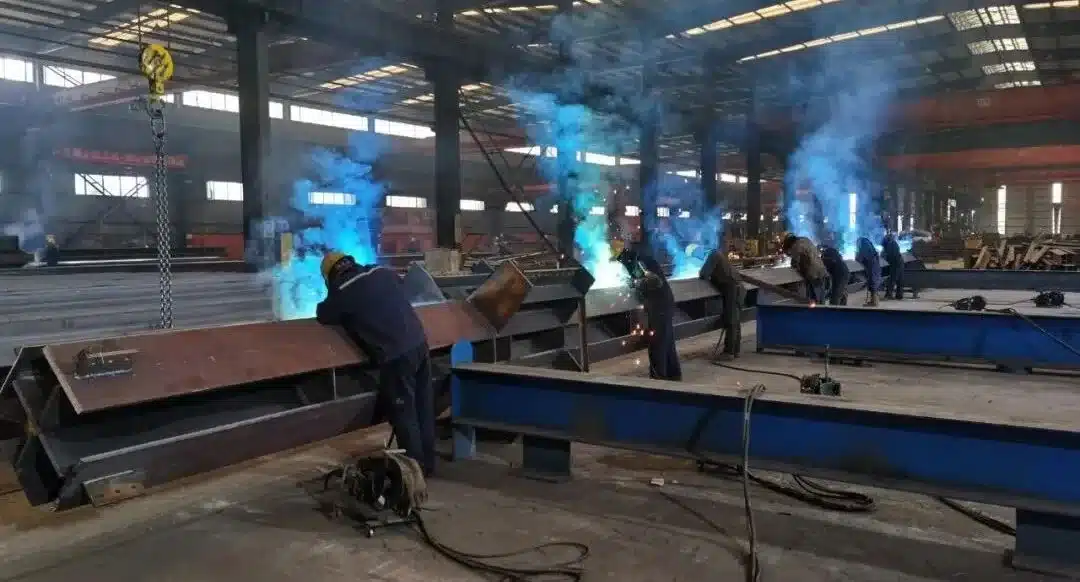
The original article’s significance lies in this coordination theme. It records collaborative production activity, not a basis for claims about round-the-clock work, exceptional individual rankings, or the entire project’s delivery. Those promotional formulations have been removed. The useful engineering question is how distributed production is managed so that components made in different locations fit the same contractual and technical framework.
Key Interfaces for Distributed Fabrication
| Interface | Coordination need | Evidence for review |
|---|---|---|
| Technical information | Common drawing and specification revision status | Controlled transmittals and revision register |
| Material | Consistent identification and traceability rules | Certificates, heat mapping, receiving records |
| اللحام | Applicable procedures, qualifications, and inspection points | WPS/PQR references, welder records, weld maps |
| Dimensions | Shared datums, tolerances, and trial-fit strategy where required | Inspection reports and survey records |
| Release | Clear status before coating, packing, or dispatch | Hold-point sign-off and release note |
| Logistics | Alignment of component geometry, route, handling, and sequence | Load plan, route review, permits where applicable |
These are recommended review areas rather than a list of source-verified project documents. A purchaser should confirm which controls applied to the actual package and obtain current records before relying on them.
Quality Planning Across Facilities
A multi-plant quality plan should establish one hierarchy of technical requirements. If facilities interpret tolerances or inspection stages differently, inconsistencies may appear only during assembly or installation. Central clarification routes, agreed inspection templates, and periodic cross-plant reviews can reduce that risk. Where components interface, the plan may require dimensional correlation, match marking, controlled assembly, or trial fitting depending on design and contract requirements.
Nonconformity control also needs a shared process. A deviation identified in one plant may affect a mating component produced elsewhere. Records should therefore identify affected parts, technical disposition authority, required reinspection, and any drawing or bill-of-material updates. Procurement teams should ask how information is propagated, not merely whether each facility has its own procedure.
A Source-Reported 28-Metre Transport Detail
The source caption reports that a 28-metre-long component was transported in one piece. That number is presented only as a source-reported project detail; it has not been independently verified here. It should not be treated as a standard product dimension, a routine logistics capability, or evidence that the same approach is suitable for another route.
Long components require project-specific transport engineering. Reviews may cover route geometry, legal limits, vehicle configuration, supports, tie-down design, load distribution, turning envelopes, overhead clearance, escort or permit requirements, delivery windows, weather, unloading space, and lifting interfaces. The most economical fabrication split is not always the most economical delivered solution. Early dialogue between design, fabrication, logistics, and site teams can compare whole-component transport with engineered splices or other segmentation strategies.
Engineering and Procurement Value
For engineers, distributed fabrication can support schedule planning if interface geometry and change control are mature. It can also expose a project to rework if information is released unevenly. Package planning should identify interface-critical components, required survey data, connection assumptions, transport constraints, and the party authorized to resolve discrepancies.
For buyers, capacity should be evaluated at the network level and at each proposed facility. A useful assessment examines equipment envelopes, personnel, welding processes, inspection resources, coating capability, material flow, current workload, subcontracted operations, and document systems. The manufacturing schedule should identify which plant produces each lot and how shared milestones are controlled.
- Request a plant allocation and responsibility matrix with the tender.
- Confirm that all facilities will use the contract’s approved technical baseline.
- Place surveillance points according to risk and interface criticality.
- Review transport assumptions before freezing component lengths and splice locations.
- Require one consolidated manufacturing record index for the contracted package.
Scope Discipline in Project Reporting
The source supports reporting on multi-plant production coordination associated with the Jing’ao project. It does not establish Zhonghengfeng’s responsibility for the project’s complete engineering, procurement, construction, installation, commissioning, or outcome. Current readers should verify the original contract package and any later changes if that distinction is material to qualification.
To review a steel fabrication package involving multiple facilities, oversized components, inspection coordination, or delivery sequencing, please تواصل معنا. Sharing drawings, specifications, component envelopes, destination constraints, and schedule priorities will support a more precise technical discussion.