
A short steelwork programme is often presented as a simple demand for more labour and longer shifts. In practice, compressed schedules are won or lost through system readiness: released design information, qualified resources, available material, fabrication capacity, transport slots, cranes, access and inspected work fronts must align in the correct sequence.
Acceleration cannot rescue an unrealistic baseline. Before committing to a date, owners and EPC teams should test dependencies and constraints, then decide which activities can genuinely overlap without transferring unmanaged risk to fabrication or erection.
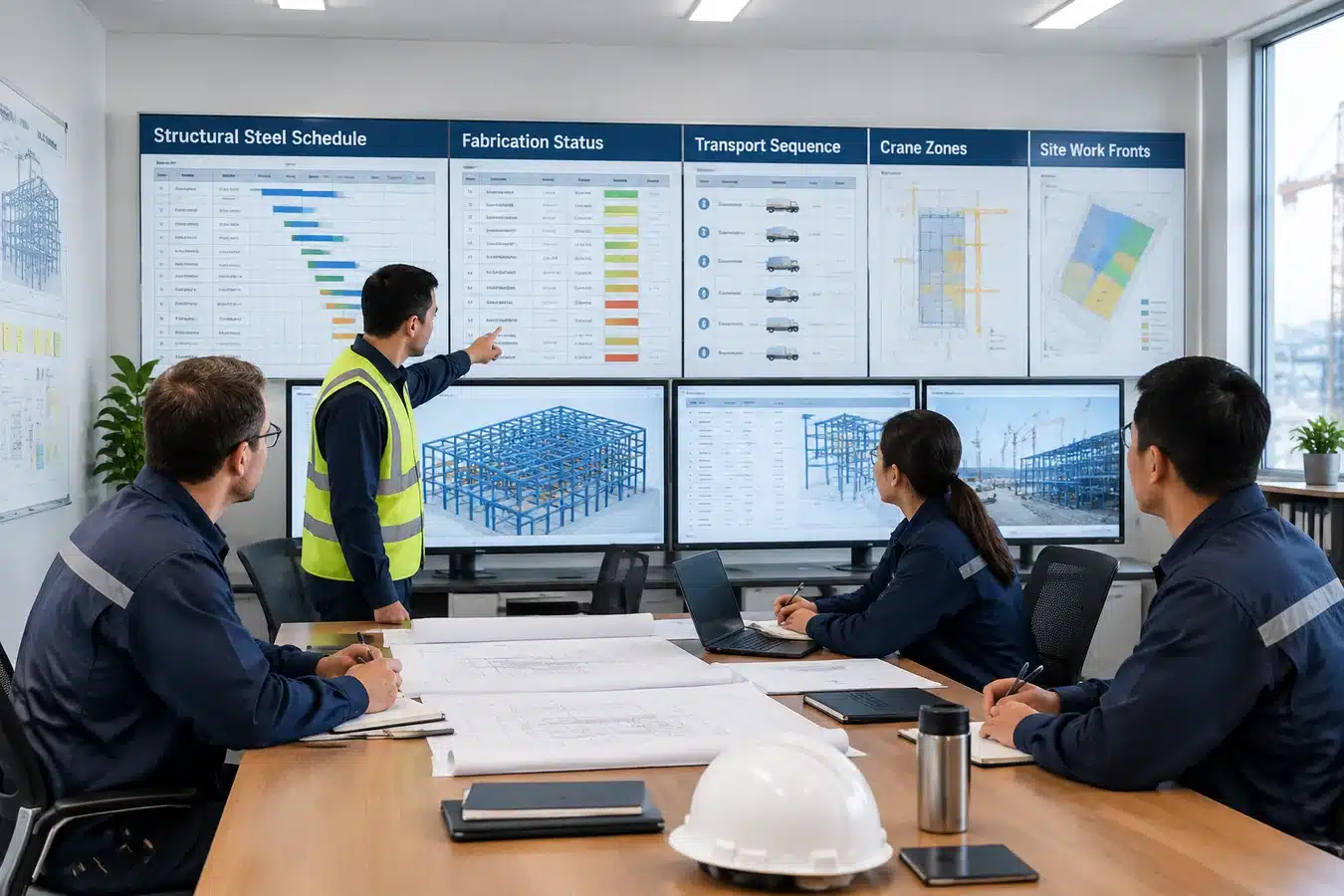
Define “ready” before acceleration begins
A credible programme distinguishes a target date from an executable plan. The team should establish the design basis, responsibility matrix, approval times, procurement status, fabrication route, shipping assumptions, erection sequence and acceptance gates. Unresolved interfaces should appear as programme risks, not hidden float.
| Readiness area | Minimum question | Typical evidence |
|---|---|---|
| الهندسة | Is the work package released and coordinated? | Approved drawings, model status and revision register |
| Materials | Are grades, sizes and bought-out items available? | Procurement schedule and mill documentation |
| التصنيع | Can the required sequence pass through each process? | Shop loading and constraint plan |
| Logistics | Can loads reach site in erection order? | Route, permits, packing and delivery slots |
| Site | Are foundations, access and lifting zones released? | Survey, handover and lift readiness records |
Use backward planning from installation needs
Backward planning starts with the erection sequence and calculates when each assembly must arrive, when it must leave the plant, and when drawings and material must be available. This connects the master programme to practical work packages.
The logic should include inspection, coating cure, packing, transport restrictions, customs where applicable and contingency. Shipping early is not always helpful: steel delivered out of sequence consumes laydown space, increases handling and can block the pieces needed next.
Staff competence, not headcount
Adding people can reduce productivity if supervision, access, tools and induction do not scale with the workforce. Critical roles may include welding supervisors, qualified welders, inspectors, riggers, crane teams, surveyors, coating personnel and document controllers. Their qualifications and availability should be verified against jurisdictional and project requirements.
Labour plans must also address accommodation, transport, welfare, language, work permits and site induction where relevant. These are legitimate schedule activities. A worker is not productive merely because a mobilisation date appears in a spreadsheet.
Create parallel work fronts carefully
Dividing the project into stable zones or erection units can enable parallel progress. Each zone needs clear boundaries, drawings, materials, equipment, supervision and acceptance criteria. Interfaces—such as shared cranes, temporary works, access roads and surveying control—must be actively managed.
- Sequence fabrication to the planned erection order.
- Separate work areas where simultaneous operations would create conflict.
- Use daily constraint reviews to remove blockers before shifts begin.
- Maintain short look-ahead plans linked to the controlled baseline.
- Protect inspection points; do not bury incomplete work behind later trades.
Keep quality gates in the critical path
Acceleration frequently creates rework when drawings change after cutting, welds proceed without approved procedures, or inspection is called too late. Hold points should be included as real programme activities, with realistic notification and response times.
Traceability also becomes more important when multiple shifts and subcontractors operate simultaneously. Piece marks, material identity, welder records, nonconformance status and inspection release should remain visible. Digital tools can help, but only if field data is timely and responsibilities are clear.
Control fatigue and simultaneous operations
Longer hours may provide a temporary output increase, but fatigue raises the probability of errors and incidents. Shift design should comply with applicable law and the project’s safety system, with defined rest, supervision and handover arrangements. Equipment capacity and maintenance windows must also be protected.
Simultaneous operations need special review. Lifting over occupied areas, hot work near coatings, mobile plant crossing pedestrian routes and trades sharing incomplete structures can quickly turn a planned overlap into a shutdown.
Integrate design change and commercial decisions
Accelerated delivery makes late change especially expensive. A seemingly minor revision can affect detailing, material nesting, welding, coating, packing and erection stability. The change process should identify affected pieces, stop obsolete work, record the revision and quantify schedule consequences before authorisation. Informal site instructions or uncontrolled model exchanges create a high risk of fabricating the wrong configuration.
Commercial incentives should support reliable flow and accepted output, not encourage unsafe driving, skipped inspection or quantity without quality. If acceleration has a premium, the basis should be transparent: additional shifts, tooling, supervision, testing capacity or logistics. Owners should also define who bears the effect of late approvals, access restrictions and scope changes.
Manage handovers between shifts and organisations
Many failures occur at interfaces rather than within individual tasks. Shop-to-site handover should identify delivery contents, inspection release, preservation needs and known constraints. Shift handovers should record incomplete joints, temporary conditions, quarantined material, open permits and equipment status. A short structured handover prevents the incoming team from repeating work or assuming that an unmarked area is complete.
Subcontract boundaries deserve the same discipline. Responsibility for surveying, temporary works, bolt supply, touch-up coating, crane coordination and final records should be allocated in advance. Where two parties share a task, the acceptance point and evidence should be explicit.
Measure flow, not just activity
Useful indicators include released drawing packages, tonnes or assemblies accepted at each shop stage, constraint closure, delivery reliability, erection completion by zone, inspection first-pass yield and rework hours. A large amount of work in progress can conceal poor flow.
When recovery is required, compare options transparently: resequencing, additional shifts, extra tooling, alternative transport or revised construction methodology. Each option should state cost, risk, decision deadline and expected schedule gain. Some dates cannot be achieved responsibly; early escalation is better than a late surprise.
A controlled schedule is a supply-chain outcome
Compressed steel programmes depend on coordinated engineering, procurement, fabrication, logistics and field execution. Resource organisation matters, but it must operate inside approved technical, quality and safety controls. Owners should evaluate a supplier’s plan and evidence, not accept speed claims alone.
To discuss fabrication sequencing and delivery interfaces for a prospective steelwork package, please اتصل بنا.